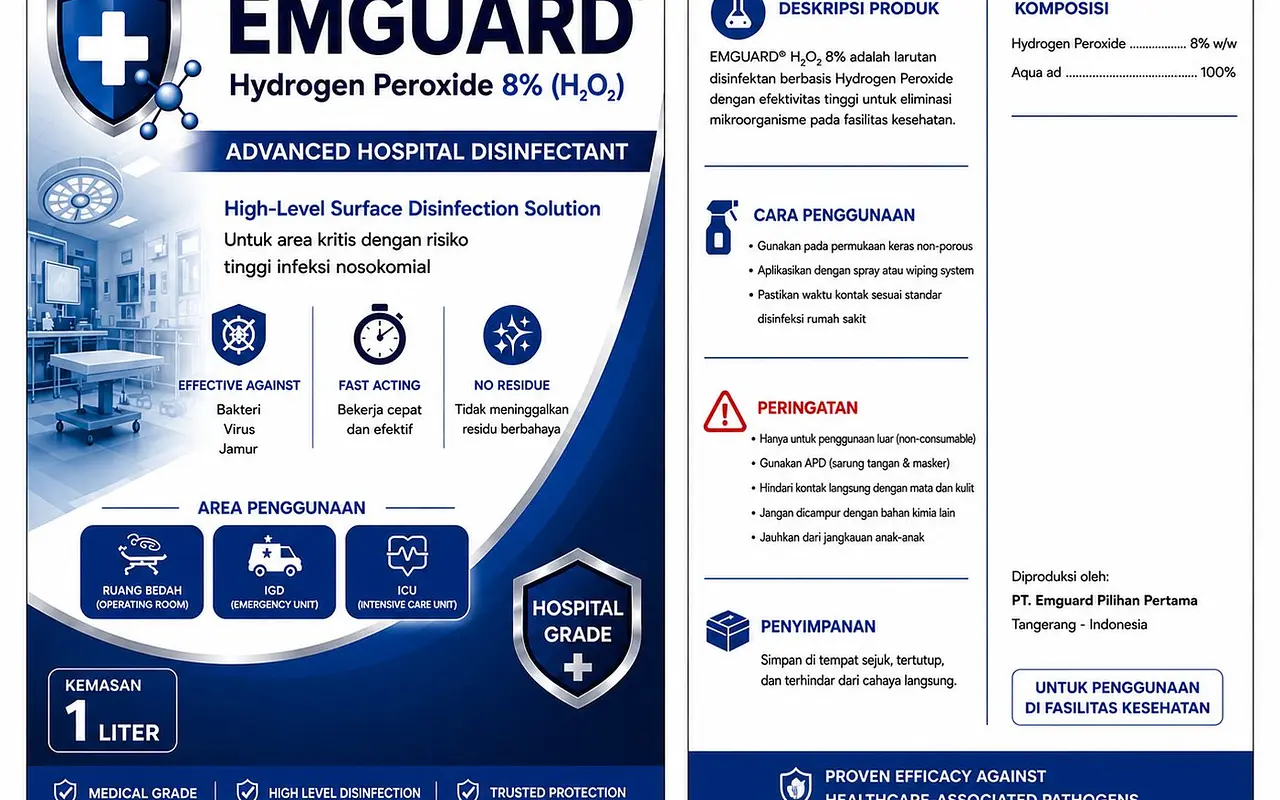
Hydrogen peroxide (H2O2) is not new to medicine — but an 8% formulation with modern stabilizers makes it one of the most efficient hospital disinfectants available today. This article explains why.
What makes H2O2 different
Most chlorine-based disinfectants leave a residue that can corrode surfaces and metal instruments. H2O2, by contrast, breaks down into water and oxygen — no chemical residue remains after 10–15 minutes of contact.
For facilities sensitive to cross-contamination — operating rooms, ICUs, NICUs — this property saves re-cleaning time and reduces the risk of patient reactions.
Concentration: why 8% and not 3%?
The 3% H2O2 sold in pharmacies is fine for minor wounds and light disinfection, but it does not meet hospital infection-prevention standards. An 8% formulation — with the correct contact time — is effective against vegetative bacteria, enveloped viruses, and many spores.
Suitable surfaces
- Hard non-porous surfaces: examination tables, trolleys, door handles
- Non-critical and semi-critical instruments (with pre-cleaning)
- Isolation-room floors
Not recommended for: textiles, porous surfaces, or direct food-contact applications without rinsing.
When 8% H2O2 is not the answer
For decontaminating massive blood spills or Risk Group 3+ pathogens, protocols may still call for a sodium hypochlorite or aldehyde combination. H2O2 is an intermediate-to-high-level disinfectant, not an absolute sterilant.
The Emguard team helps facilities build area-based cleaning standards rather than a one-product-fits-all approach. Consult us via the WhatsApp button below.