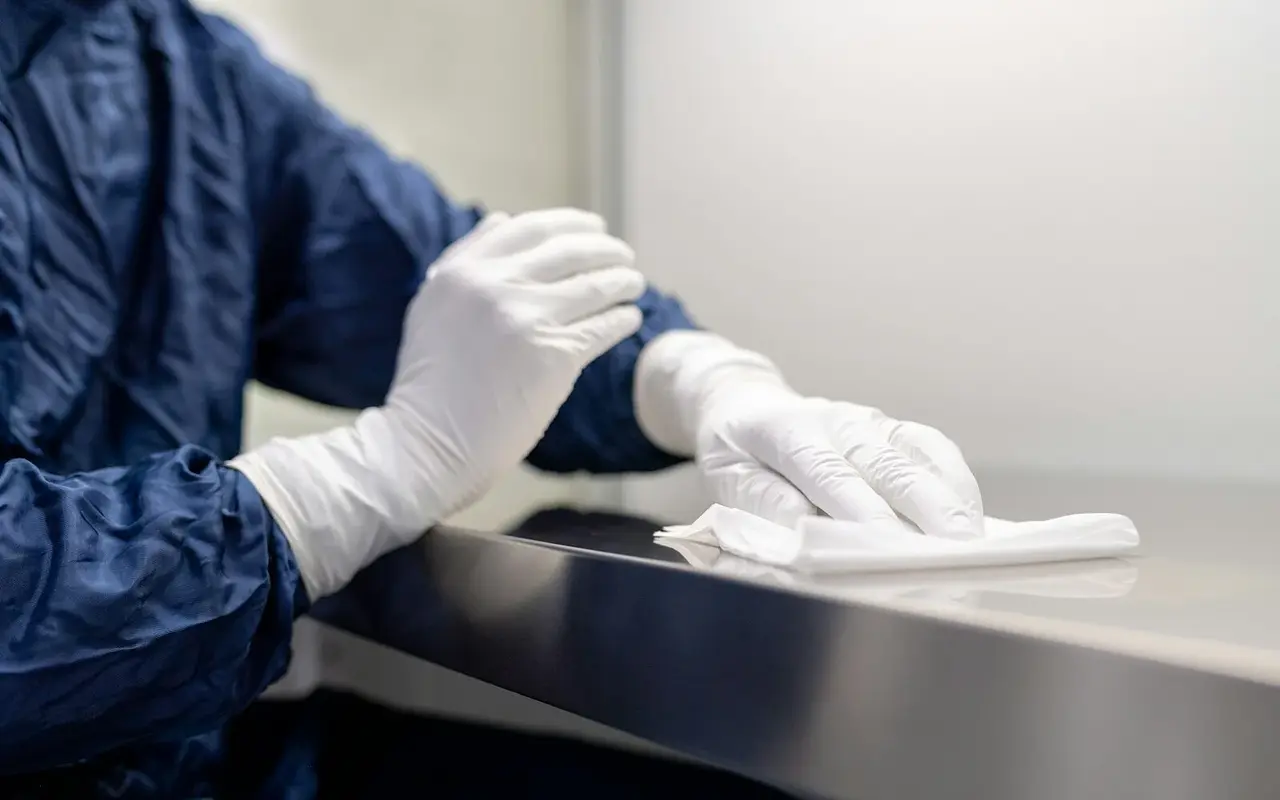
A scene common in hospitals, clinics, and factories: a worker sprays disinfectant onto a counter, then immediately wipes it dry within 2–3 seconds. The surface looks clean, there's a sharp "medical" smell, the job is considered done. But microbiologically, almost nothing has happened.
What's missing is contact time — the single most important variable for disinfection success, and the one most often ignored.
What contact time means
Contact time (also called "dwell time" or "wet contact time") is how long a disinfectant must remain wet on a surface for the pathogen load to drop to a level considered safe — typically a 4 to 6 log reduction (99.99% to 99.9999%).
Every disinfectant has a contact time established by lab testing against specific pathogens. The number is printed on the product label, in the efficacy report, or in the Material Safety Data Sheet. It isn't a suggestion or a flexible range — it's the outcome of ASTM/EN testing that backs the product's claims.
Why "spray-and-wipe" fails
When disinfectant sits for 5 seconds and is then wiped dry, what actually happens:
- The chemical reaction stops early. Hydrogen peroxide, chlorhexidine, or quaternary ammonium compounds need time to penetrate the microbial cell wall. Wiped dry = the pathogens are still alive.
- The cloth becomes a contamination vector. Microbes that were stirred up but not yet killed stick to the cloth and get spread to the next surface.
- Residue is no longer controlled. Some formulations leave an active film that continues working after application. Wiping it off ends that protection earlier than designed.
The end result: the surface looks clean, a visual audit passes, but microbiology swabs still show pathogen load. This is why choosing the right disinfectant is the first step, not the only one.
Typical contact times for common disinfectants
The figures below are typical ranges for Risk Group 1–2 pathogens. Always check the label of the specific product you use.
Disinfectant type Vegetative bacteria Enveloped viruses Spores / TB Hydrogen peroxide 7–8% 5 min 5–10 min 10–15 min Sodium hypochlorite 1,000 ppm 1 min 1–5 min 5–10 min (limited spore activity) Chlorhexidine 4% (skin) 15–30 sec — not effective Alcohol 70% (hand rub) 30 sec 15–30 sec not effective Quaternary ammonium 5–10 min 10 min not effectiveThese are minimum contact times — if the surface is dirty, organic, or cold, longer is required. The key: the surface must stay visibly wet for the entire period. If it dries early, reapply.
The correct 3-step protocol
1. Pre-clean (remove gross soil first)
A disinfectant is a microbe killer, not a cleaner. Dried blood, dust, or food residue physically blocks the disinfectant from reaching the surface. Wipe down first with a damp microfibre cloth or mild detergent, then move to disinfection.
2. Apply (spray or wipe evenly)
Make sure the entire target area is genuinely wet — not just lightly misted. For a 1 m² counter, a hand sprayer typically needs 6–10 sprays to give even coverage.
3. Dwell (let it stay wet until the contact time is met)
This is the step most often skipped. Set a timer for 5–10 minutes (per product). Don't wipe, don't blow. After the time is up, allow it to air-dry if possible — or wipe with a clean dry cloth only if the surface must be used immediately.
The most common field mistakes
- Solution diluted too much. "Saving" by reducing concentration voids the efficacy claim. Use the dose printed on the label.
- Spray bottles used to empty without rotation. Disinfectants have a shelf life after opening — sodium hypochlorite loses ~50% potency in 30 days if the bottle is often opened.
- One mop cloth used across an entire wing. One cloth per area or per patient, washed at minimum 60°C between uses.
- The same contact time treated as applying to all pathogens. Spores take much longer. For post-isolation decontamination (e.g. a C. difficile patient), use a specific protocol with the appropriate contact time.
- Disinfectant mixed with soap or another cleaner. This almost always inactivates the disinfectant. Pre-clean, rinse, then disinfect.
How to measure compliance at your facility
A claim of "we already disinfected" without data can't be audited. Three minimum methods:
- Direct observation. A senior officer / IPC nurse watches actual technique in the field, scoring against the SOP. Ideally a blind audit — no advance notice.
- ATP swab test. Measures organic residue (a proxy for cleanliness) with a luminometer. Fast, quantitative. Doesn't directly measure microbes, but is a strong indicator.
- Microbiology swab. Sample the surface after disinfection, culture in the lab. Gold standard, but slow (2–5 day results).
Many facilities use a combination: daily ATP for hot spots, monthly microbiology swabs for validation.
Summary
Even the best disinfectant on the market won't work if its contact time is cut to 3 seconds. Check the product label, set up an SOP with timers, and measure compliance — don't assume it.
The Emguard team supplies printed SOPs and contact-time labels for every disinfectant we sell: H2O2 8%, chlorhexidine, hand rub, and others. We can also help you build a simple audit kit a supervisor can use daily. Let's discuss via WhatsApp below.