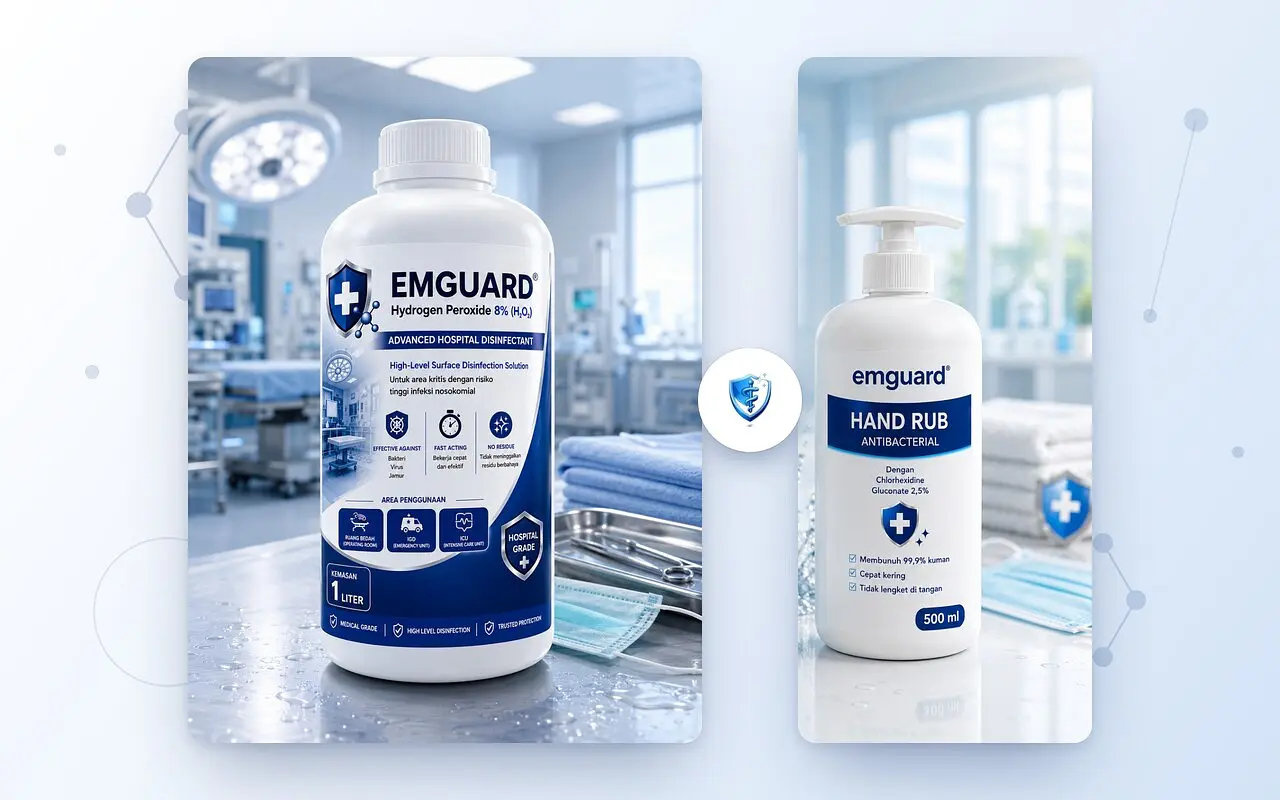
In many healthcare facilities, two terms get used interchangeably as if they were synonyms: "disinfectant" and "antiseptic". They are not the same — and choosing wrong can mean wasted budget, irritated staff skin, or, most dangerously, an area assumed clean that isn't. Here is the difference, explained in full.
The core difference: living tissue vs inanimate objects
Both kill or inactivate microorganisms. But the most fundamental distinction is where each may be used:
- An antiseptic is used on living tissue — skin and hands, including skin preparation before a procedure. It is formulated to be gentle enough not to damage skin cells.
- A disinfectant is used on surfaces and inanimate objects — examination tables, floors, trolleys, door handles, instruments. It is generally stronger, and many are irritating or corrosive on skin.
Hold this line: antiseptics for the living, disinfectants for the inanimate.
Why the two can't be swapped
Using a surface disinfectant on hands isn't just "stronger" — its formulation simply isn't designed for skin. The risks are irritation, contact dermatitis, even chemical burns; some agents are also unsafe if absorbed through skin.
Conversely, using an antiseptic to mop floors looks harmless but is also wrong: antiseptics are formulated for skin conditions, not for surfaces carrying an organic soil load. The result is an area assumed disinfected that isn't — and because antiseptics cost far more per liter, this use is also wasteful.
The confusing part: same active ingredient, different purpose
What often triggers the mix-up: sometimes the active ingredient really is the same. Chlorhexidine gluconate is used at 2–4% as a hand antiseptic (hand rub, surgical scrub). Alcohol at 70% is an effective hand antiseptic, while high-level surface disinfection often uses other compounds such as hydrogen peroxide.
The lesson: "the same ingredient" does not mean "usable for anything". What determines the intended use is the formulation, concentration, and additives — not the name of the active ingredient alone.
Not just two categories — a spectrum
Beyond antiseptics and disinfectants, other levels are worth understanding:
- Sanitizer — reduces microbial counts to a level considered safe; does not eliminate all.
- Disinfectant — inactivates nearly all pathogenic microbes on surfaces, though not necessarily spores.
- Sterilant — kills all microbial forms, including spores; used for critical instruments.
Disinfectants themselves have tiers: low-level, intermediate-level, and high-level. High-level disinfectants (e.g. hydrogen peroxide-based) cover a broader spectrum.
Practical guide: which situation, which product
- Medical staff hands before and after patient contact use an antiseptic (alcohol- or CHG-based hand rub).
- Routine handwashing with running water uses an antiseptic (antibacterial hand wash).
- Surgical team hand preparation before an operation uses an antiseptic (surgical hand scrub).
- Examination-room surfaces, trolleys, and door handles use a surface disinfectant.
- Isolation-room floors and high-risk areas use a disinfectant — consider high-level.
- Semi-critical instruments use a high-level disinfectant, following the pre-cleaning protocol.
Conclusion
Understanding the difference between disinfectants and antiseptics isn't about terminology — it's about patient safety and cost efficiency. The Emguard line is deliberately split along the same boundary: Hydrogen Peroxide 8% as a surface disinfectant, and the Hand Rub, Hand Wash, and Hand Scrub range as hand antiseptics.
To go deeper, also read Hydrogen Peroxide 8%: The Hospital Disinfectant That's Often Misunderstood.
Need help building a which-to-use-where standard for your facility? The Emguard team is ready to discuss via WhatsApp.