Bacteria
Vegetative Gram-positive & Gram-negative bacteria, including common nosocomial pathogens: Staphylococcus aureus (including MRSA), Escherichia coli, Pseudomonas aeruginosa, Klebsiella pneumoniae, Acinetobacter baumannii.
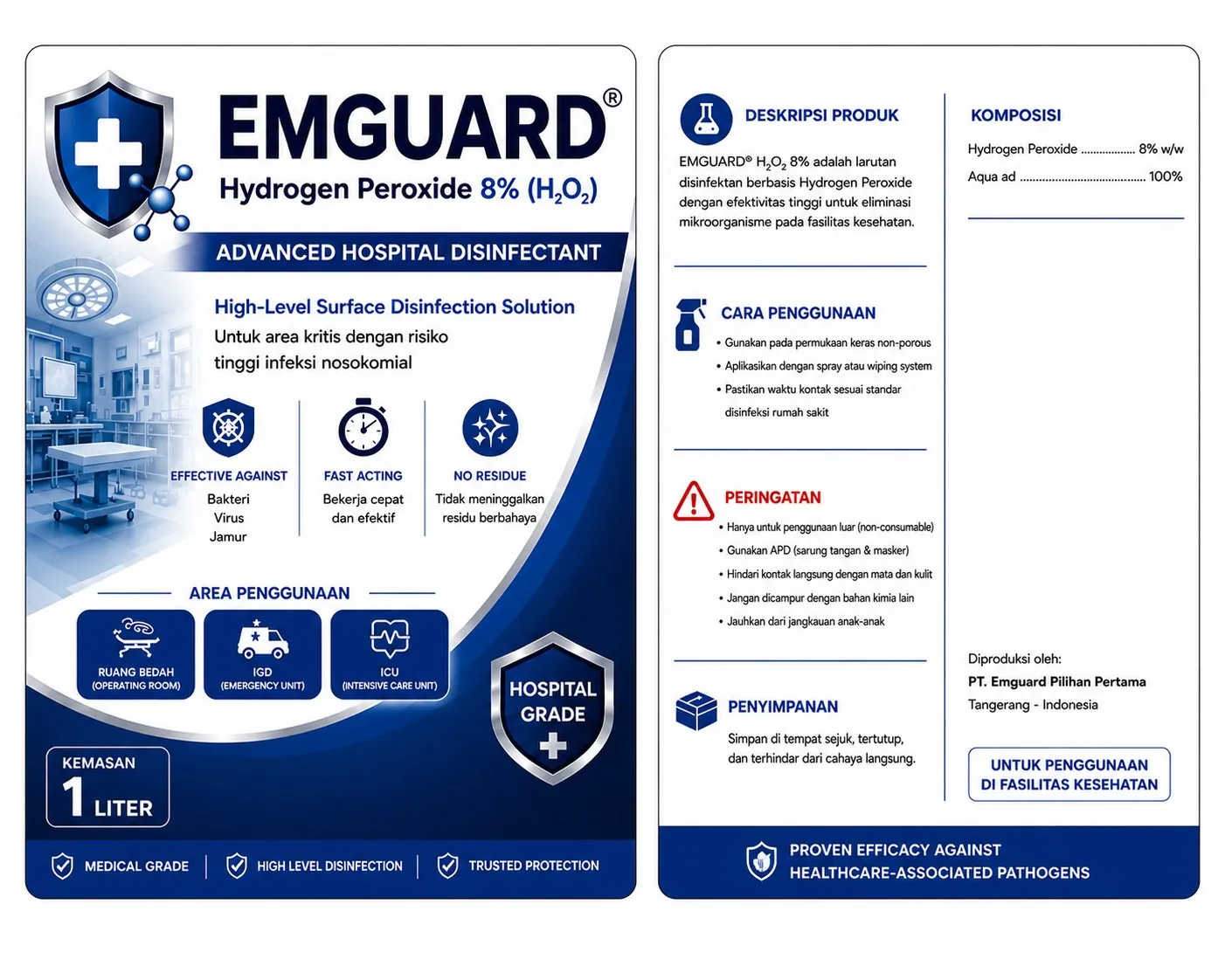
Hydrogen peroxide (H₂O₂) is a powerful oxidising molecule that works biologically through the release of hydroxyl radicals (•OH) — the most aggressive reactive oxygen species known to the chemistry of life. At a concentration of 8%, it sits at a deliberately engineered point of balance: strong enough to rapidly inactivate microorganisms, yet controlled enough to be used safely on clinical surfaces alongside standard hospital working procedures.
EMGUARD® H₂O₂ 8% works through an oxidative mechanism that attacks the vital structures of a microbial cell simultaneously. There is no single pathway — instead there is a convergence of damage, making resistance difficult to develop.
Hydroxyl radicals attack the unsaturated fatty acids of the cell membrane, triggering lipid peroxidation that compromises membrane integrity. The cell loses its ability to retain its intracellular contents.
Sulfhydryl groups (–SH) on key enzymes are oxidised into abnormal disulfide bonds. Metabolic enzymes lose their tertiary structure — the cell's life processes come to a halt.
Oxidation of nitrogenous bases, particularly guanine, produces 8-oxoguanine lesions that prevent replication and transcription. The microbe loses its ability to reproduce.
After acting, H₂O₂ decomposes into H₂O and O₂ — leaving no hazardous chemical residue on the surface. This is the basis of the no residue claim that sets H₂O₂ apart from chlorine or quaternary ammonium.
Designed to inactivate the spectrum of clinically relevant pathogens in healthcare facilities — from surface-contaminant bacteria to the viruses most feared by infection prevention and control teams.
Vegetative Gram-positive & Gram-negative bacteria, including common nosocomial pathogens: Staphylococcus aureus (including MRSA), Escherichia coli, Pseudomonas aeruginosa, Klebsiella pneumoniae, Acinetobacter baumannii.
Enveloped viruses such as SARS-CoV-2, Influenza, HIV, Hepatitis B & C. Also effective against more resistant non-enveloped viruses, such as Norovirus and Adenovirus, with the appropriate contact time.
Pathogenic fungi and yeasts including Candida albicans, Candida auris, and Aspergillus spp. — relevant for infection control in immunocompromised patients in ICUs and isolation rooms.
The market offers H₂O₂ at a range of concentrations — 3% for wound cleaning, 35% for industrial use, and 7.5% fogging systems common in European hospitals. EMGUARD chose 8% w/w as the clinical point of balance: concentrated enough for short contact times and high-level efficacy on surfaces, yet controlled enough that housekeeping staff can use it with standard PPE — not industrial gear.
This concentration is also consistent with high-level disinfection (HLD) recommendations for hard, non-porous surfaces in critical areas, in line with international practice that positions H₂O₂ as a cleaner alternative to chlorine bleach and a safer one than aldehydes.
Every critical area of a hospital has its own microbiological profile. EMGUARD® H₂O₂ 8% is designed for locations where consistent disinfection results determine patient safety.
Hospital disinfection standards demand a procedure that any housekeeping shift can repeat. The following is the EMGUARD® H₂O₂ 8% usage SOP, designed to be as concise as possible without sacrificing precision.
Disinfection is not cleaning. Remove organic soil (blood, mucus, dust) with a neutral detergent, then dry. Organic matter inactivates the oxidiser.
Spray evenly over hard, non-porous surfaces, or apply via a moistened microfibre wipe. Ensure the entire surface is uniformly wet.
Leave the solution wet on the surface for the contact time required by the facility SOP — generally 1–5 minutes for routine disinfection. Do not wipe dry too quickly.
H₂O₂ will decompose into water and oxygen — no additional rinsing is required for non-food-contact surfaces. No chemical residue is left behind.
Technical details ready to be attached to procurement documents, infection prevention and control evaluations, or your facility's formulary.
EMGUARD® H₂O₂ 8% is a hospital-grade product for external use on surfaces. Every operator must understand the following safety guidance before routine use.
Must not be swallowed, must not be used as a wound antiseptic, and must not be applied to human or animal skin.
Nitrile gloves and a surgical mask at minimum. For fogging applications or enclosed spaces, add protective goggles and adequate ventilation.
In the event of contact, rinse immediately with running water for at least 15 minutes. Consult a medical professional if irritation persists.
In particular, avoid mixing with acetic acid (vinegar), chlorine bleach, or ammonia detergents — the reaction may produce hazardous gases or reduce disinfectant efficacy.
Store in a locked storage cabinet in the hospital's logistics or housekeeping area, separate from medicines and consumable goods.
Behind every surface we disinfect there is a patient who has just left the operating theatre, a nurse holding the three-in-the-morning shift, and a family waiting outside the ICU. EMGUARD® H₂O₂ 8% is not merely a chemical — it is the technical assurance we give to the team that keeps that trust.
Our technical team is ready to help evaluate your disinfection protocols, provide MSDS, test certificates, and dosing guidance aligned with your facility SOP — ready for presentation to the infection prevention and control committee or environmental auditors.