A septic tank that fills up fast, needs pumping every few months, and gives off a foul smell is one of the most common complaints in homes and buildings alike. Most people's first reaction: pump it more often. But that only treats the symptom. The root cause is often not the size of the tank — it is biology. Here are the real causes and the fix.
Briefly: how a septic tank works
This matters, because the problem starts here. When wastewater enters a septic tank, three things happen:
- Heavy solids settle to the bottom, forming sludge.
- Oil and grease float to the top, forming a scum layer.
- The relatively clear liquid in the middle (effluent) flows out toward a drain field.
Inside the tank, anaerobic bacteria — bacteria that live without oxygen — continuously break down the sludge. This is the part most often overlooked: a septic tank is not just a holding pit, it is a biological reactor. If its bacteria work well, sludge is digested and its volume is kept down. If they don't, sludge piles up without end.
Why a septic tank fills up fast
"Full" almost always means sludge is accumulating faster than it can be digested. The most common causes:
- Decomposer bacteria killed off or too few. Bleach, phenolic cleaners, antibacterial cleaners, drain-cleaning chemicals, and medication residues entering the drains kill anaerobic bacteria. With no bacteria, nothing digests the sludge.
- Oil and grease. Cooking oil poured down the sink congeals into a thick scum layer that is hard to digest and builds up fast.
- Non-degradable waste. Wet wipes (including those labeled "flushable"), sanitary pads, diapers, and cigarette butts never break down — they only accumulate.
- A clogged drain field. If effluent cannot soak away (a blocked soakaway, water-saturated soil), liquid pools in the tank and the tank seems "full" when the real problem is the drain field.
- Excess water inflow. Very heavy water use or leaking taps and toilets push solids out before they can settle, and overload the drain field.
- Never desludged. With no maintenance at all, sludge will of course eventually fill the tank.
Why a septic tank smells
Breaking down waste does produce gases: hydrogen sulfide (a rotten-egg smell), methane, and ammonia. But a healthy septic tank should not give off a strong smell into the house — those gases rise and exit through the vent pipe on the roof.
If the smell is strong and intrusive, it is a signal something is wrong:
- Bacterial breakdown is disrupted. When bacteria die or are overwhelmed, waste putrefies incompletely and produces far more odorous gas.
- A blocked vent pipe, so gas finds its way out through indoor drains instead.
- A dried-out water seal (P-trap) — the water seal in a drain has evaporated, opening a path for gas to rise.
- An overfull tank or a saturated drain field, leaving waste and gas no room.
The overlooked root: the bacterial population
Notice the pattern: "fills up fast" and "smells" often share the same root — an inadequate population of decomposer bacteria. Without enough bacteria, sludge is not digested (it accumulates fast) and at the same time putrefies incompletely (it smells).
And without realizing it, we kill those bacteria every day: each time bleach, phenolic cleaner, or harsh cleaners in large amounts flow into the drains, part of the bacterial population dies with them. A "problem" septic tank is often really a tank that has run out of its biological workforce.
The biological fix: restoring the bacteria
The approach that targets the root cause is called bioaugmentation — adding a consortium of decomposer bacteria back into the tank. Once the bacterial population recovers:
- Sludge is digested faster and its volume is kept down — the tank fills up more slowly and the pumping interval becomes far longer.
- Digestion is more complete and waste no longer putrefies wildly — odor drops significantly.
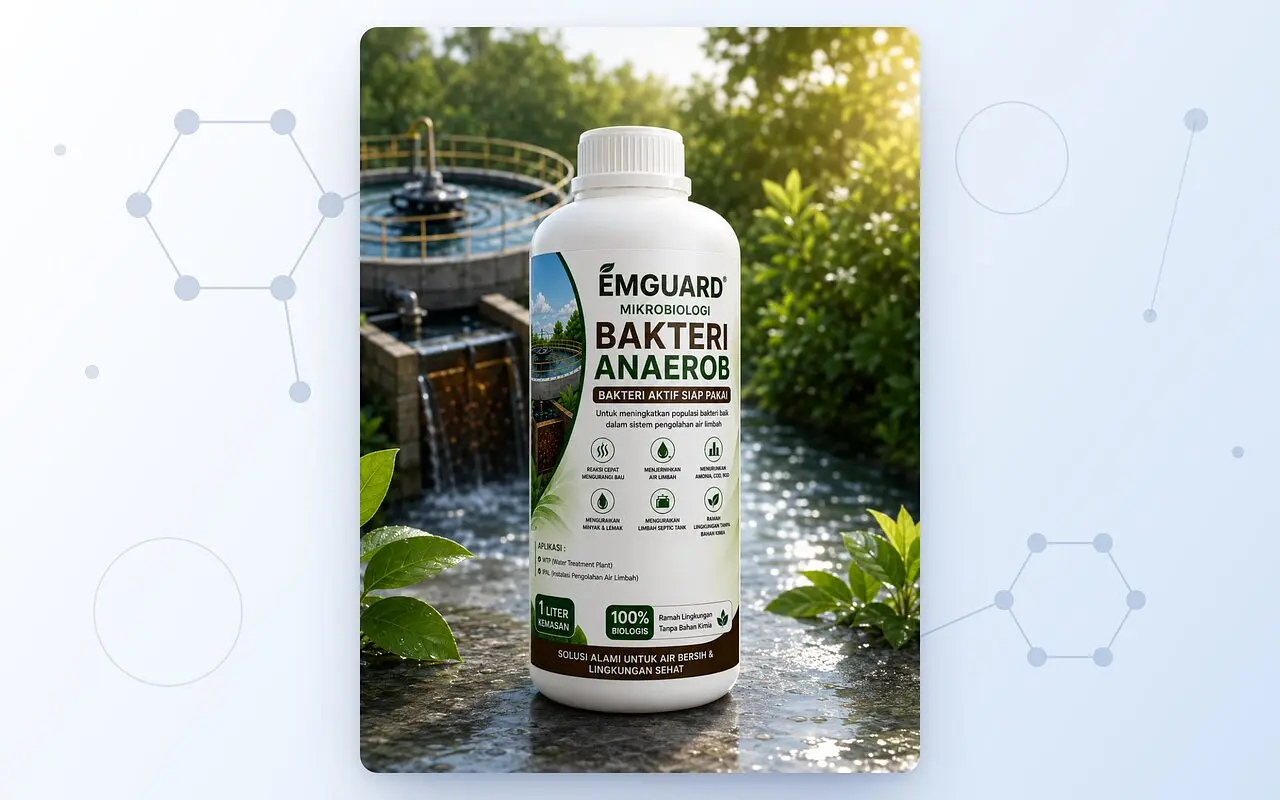
This is exactly what Emguard's Anaerobic Bacteria Microbiology is for — an active anaerobic bacteria consortium made specifically for septic tanks and biodigesters: it reduces sludge, suppresses odor, and extends the desludging interval. For larger, oxygenated systems such as wastewater treatment plants, that role is filled by Aerobic Bacteria. One thing to understand: this is not a one-shot cure but routine maintenance — the tank needs its "workforce" continually replenished.
What to do — and what to avoid
- Cut down harsh chemicals into the drains. Reasonable use is fine, but routinely pouring concentrated bleach or drain cleaner slowly sterilizes your own septic tank.
- Never pour oil and grease down the sink — collect and dispose of it separately.
- Flush only human waste and toilet paper. Wet wipes, sanitary products, and the like go in the bin.
- Make sure the roof vent pipe is not blocked.
- Check the drain field if the toilet drains slowly — the problem may be there, not in the tank.
- Maintain the bacterial population with routine top-ups, and still desludge periodically — only, with healthy bacteria, far less often.
When bacteria alone are not enough
It is important to be honest: decomposer bacteria are not a fix for everything.
- If the drain field is already completely clogged, liquid still cannot escape — the drain field needs physical repair.
- If the tank is already packed with old sludge, do one round of pumping first, then maintain it with bacteria so it does not fill up fast again.
- If there is a crack or structural leak, that is a construction problem that must be repaired.
But for the majority of "fills up fast and smells" cases on a structurally sound tank, the root is biology — and that is where bacteria do their work.
Conclusion
A septic tank that fills up fast and smells is rarely a size problem. Both usually trace to one thing: an inadequate population of decomposer bacteria, often unknowingly killed off by chemicals. The solution is not to pump more often, but to restore and maintain the tank's biology — while you stop killing it.
Emguard provides Anaerobic Bacteria Microbiology for exactly this need. To understand the broader principle of microorganism-based waste treatment, also read Microbiology Waste Treatment for Small-Scale Labs.
Want to discuss septic tank or wastewater treatment maintenance for your facility? The Emguard team is ready to help via WhatsApp.