Sludge volume down 30–60%
Converting organic carbon into biogas means solid mass is reduced. Household and communal septic tanks report desludging intervals extended from 2–3 years to 5–7 years after routine application.
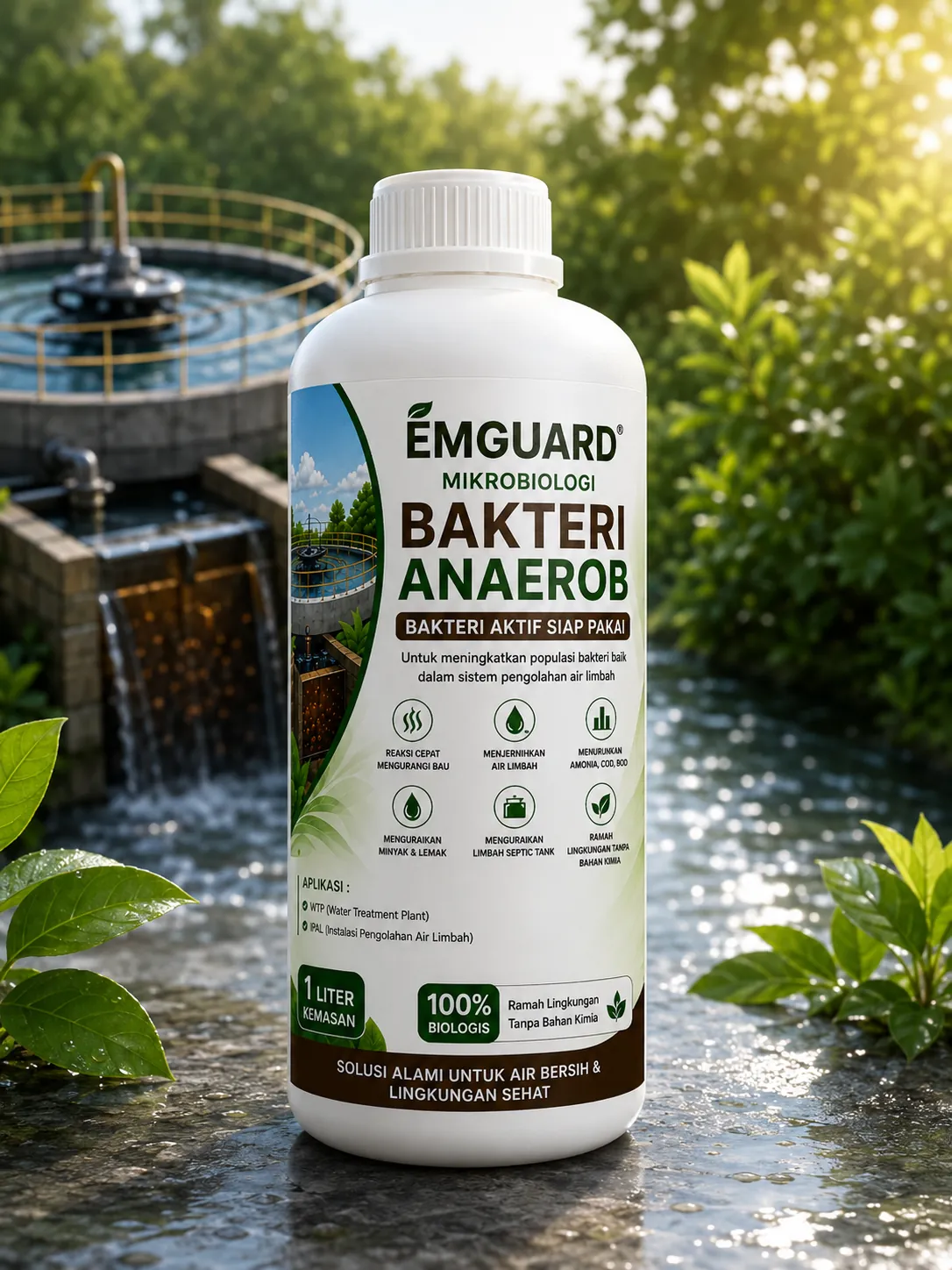
Three billion years before Earth's atmosphere held oxygen, life had already found a way to metabolise without O₂. These anaerobic communities still live today in the most inhospitable places — the guts of mammals, the bottoms of lakes, household septic tanks, and biogas biodigesters. EMGUARD® Anaerobic Bacteria is a consortium of Clostridium spp., Bacteroides, Methanobacterium, and Methanosarcina strains that work across four sequential stages to break down solid organic waste into off-gassing gases (CH₄ + CO₂) and cleaner water — not simply relocating the problem, but converting it.
Anaerobic digestion is a relay process — each group of bacteria produces the substrate for the next group. This is why a balanced consortium is far more effective than a single-strain product.
Hydrolytic bacteria secrete extracellular enzymes (cellulase, protease, lipase) that break carbohydrates, proteins, and fats into simple sugars, amino acids, and fatty acids. This is the stage that most often becomes the rate-limiting step in slow septic tanks.
The products of hydrolysis are fermented into Volatile Fatty Acids (VFAs) — acetate, propionate, butyrate — plus hydrogen and CO₂. This stage is very fast; reactor pH can drop if it is not balanced by the next stage.
Acetogenic bacteria convert propionate and butyrate into acetate + H₂. This substrate becomes the primary food source for methanogens in the final stage — a metabolic connection that must be maintained so the reactor does not stall.
Methanogenic archaea (Methanosarcina, Methanobacterium) convert acetate and H₂/CO₂ into methane — gas that flies out of the reactor. This is how organic carbon leaves the system permanently, rather than simply settling as sludge.
The three indicators most often reported by operators of septic tanks, biodigesters, and anaerobic ponds after 30–60 days of routine application of EMGUARD® Anaerobic Bacteria.
Converting organic carbon into biogas means solid mass is reduced. Household and communal septic tanks report desludging intervals extended from 2–3 years to 5–7 years after routine application.
A balanced consortium prevents the build-up of VFAs that act as odour precursors. Sulfate-reducing strains are kept in check, and H₂S gas production (rotten egg) drops drastically within 14 days.
For active biodigesters: biogas yield rises 15–40% at the same hydraulic retention time. The CH₄ composition in the biogas increases (more methane, less CO₂) — better fuel quality.
Each stage is a balance between different microbial groups — whose ratios must be maintained so the system does not stall.
The active septic products common on the market often contain only a single species — usually a simple Bacillus that works facultatively. It works at the early hydrolysis stage, but does not complete the anaerobic biochemical cascade. The result: odour drops briefly, but sludge keeps building up because the organic carbon never leaves the system as biogas.
EMGUARD® Anaerobic Bacteria is a four-stage consortium — hydrolytic, fermentative, acetogenic, and methanogenic strains working together. It mimics the natural anaerobic ecosystem proven over billions of years, rather than pinning hopes on a single all-purpose species.
From a single household septic tank to an industrial-scale biodigester — wherever organic matter settles without an active oxygen supply, an anaerobic consortium is the answer.
The operator only does two things: the initial dose and the maintenance dose. The biochemical complexity is handled by the microbial consortium itself.
The active volume (capacity in litres or m³) is the basis for calculating the dose. For a standard 2–4 m³ household septic tank, a seeding dose of just 0.5–1 L is sufficient.
Septic tank: 0.5 L per 2 m³ · Biodigester: 5–15 L per 100 m³ depending on organic load. Pour directly into the inlet point or manhole. No pre-treatment or special mixer required.
The microbial community needs time to form flocs and a stable inter-species ratio. Odour reduction is usually visible within 7–14 days; the full effect on sludge volume appears after 30–60 days.
Septic tank: 100–200 ml per month to maintain the population. Active biodigester: 1–3 L per 100 m³ per month. Temporarily increase the dose after a shock event (load surge, disinfectant dosed into the system, repairs).
Details ready to attach to septic tank or biodigester procurement documents, or anaerobic IPAL operational reports.
Non-pathogenic strains (BSL-1) — safe for operators using standard PPE. The system conditions to watch for optimal performance.
Chlorine bleach, Lysol, or peroxide entering the septic tank will kill the microbial community. Separate cleaning schedules from bioaugmentation dosing by at least 48 hours.
Methanogens are highly sensitive to low pH. A very acidic substrate supply (acid-fermentation waste) can turn the reactor "sour" — VFAs accumulate, pH drops, methanogens die. Install a buffer (alkalinity) if necessary.
A mixer that causes splashing or an open vent hole introduces O₂ that can inhibit methanogens. The system must be designed as a sealed unit with controlled gas venting.
Biogas contains flammable methane and toxic H₂S. Do not enter a biodigester chamber without a portable gas meter and adequate ventilation. Follow confined space entry procedures.
Gloves, protective goggles, mask. Do not swallow. Rinse with water if it contacts the skin. Keep out of reach of children.
A functioning septic tank is one of the quietest sanitation achievements a building can have. Unseen, unheard, odourless. Every millilitre of EMGUARD® Anaerobic Bacteria works to preserve that absence — quietly, underground, billions of cells at every moment.
Our technical team is ready to calculate the seeding dose based on your reactor volume, diagnose underperforming septic/biodigester systems, and design an annual maintenance programme that stabilises biogas and cuts desludging costs.