Organic load down
BOD₅ down 80–95% · COD down 70–90% · TSS down 60–85%. Effluent meets the Ministry of Environment regulation's quality standards for domestic and class A hospital WWTP categories.
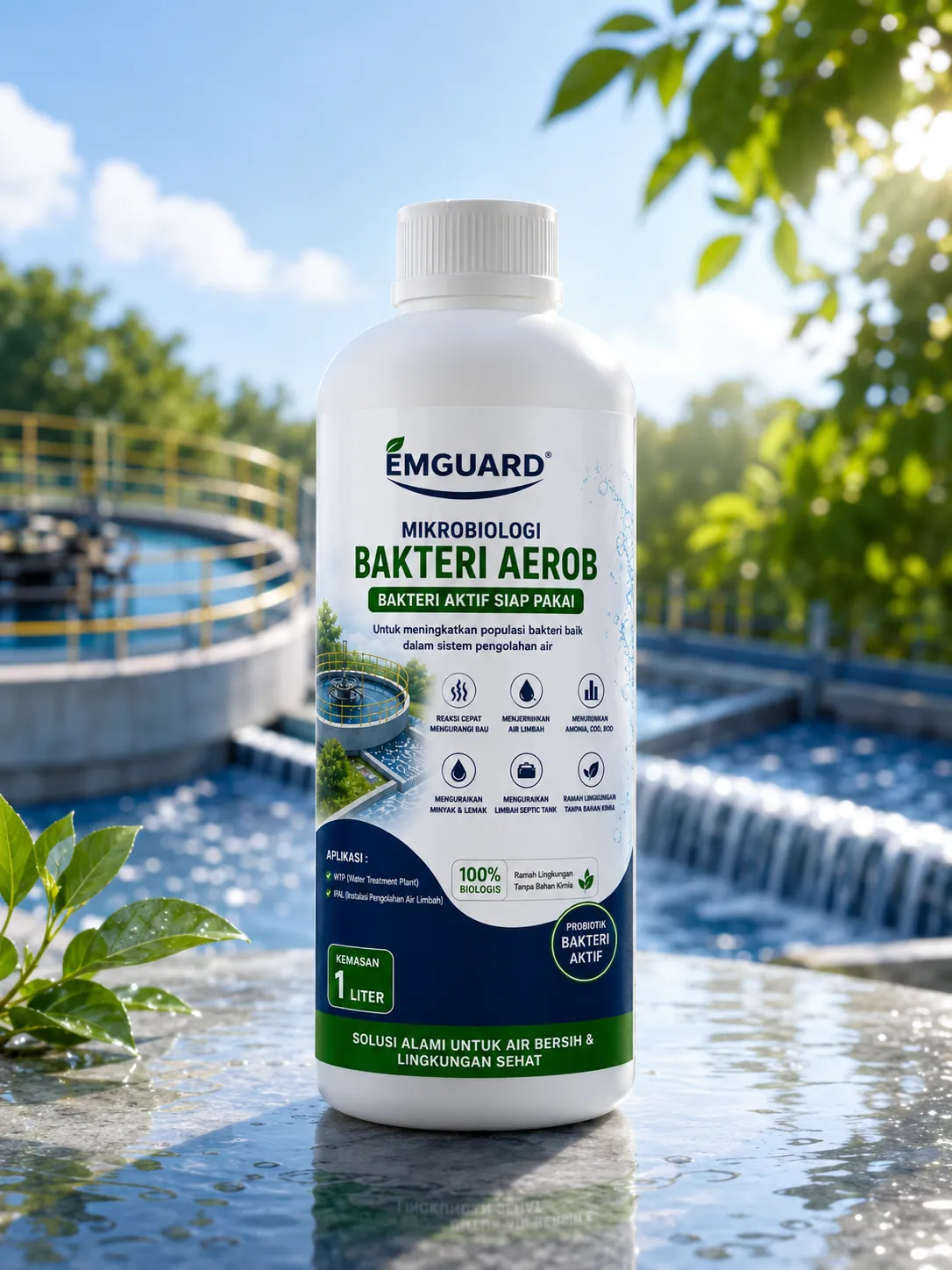
Industrial and hospital wastewater is, biologically, actually a rich nutrient medium: organic carbon, ammonia nitrogen, phosphorus, and trace elements. What it takes to transform it from a pollutant load into clean water is the right microbial community — with a balanced species composition and sufficient cell density. EMGUARD® Aerobic Bacteria is a live consortium of Bacillus subtilis, B. licheniformis, Pseudomonas putida, and the nitrifying strains Nitrosomonas & Nitrobacter, formulated to accelerate and stabilize the biological treatment process already running in your WWTP or WTP.
In a basin with sufficient oxygen supply (DO ≥ 2 mg/L), the aerobic consortium metabolizes pollutants through parallel pathways that produce new biomass, CO₂, water, and nitrate — components that can be separated or released into the environment safely.
Heterotrophic bacteria metabolize dissolved organic carbon into CO₂, H₂O, and new biomass. Measured results: BOD₅ down 80–95%, COD down 70–90% within a standard 8–24 hour retention cycle.
Nitrosomonas oxidizes NH₃ → NO₂⁻, then Nitrobacter oxidizes NO₂⁻ → NO₃⁻. This two-stage process eliminates toxic ammonia, a strictly regulated parameter in the Ministry of Environment's effluent quality standards.
Lipase enzymes secreted by Bacillus and Pseudomonas hydrolyze triacylglycerols into glycerol and free fatty acids — which are then assimilated as a carbon source. Critically important for hospital kitchen, canteen, and F&B WWTPs.
Strains are selected to form dense, easily settling flocs — improving sedimentation efficiency in the clarifier, reducing effluent turbidity, and producing more compact sludge for dewatering.
The performance indicators environmental auditors monitor — and that are reported to the Environmental Agency every month. The figures below are the ranges reported by EMGUARD clients on standard WWTPs with daily maintenance dosing after 14–30 days of adaptation.
BOD₅ down 80–95% · COD down 70–90% · TSS down 60–85%. Effluent meets the Ministry of Environment regulation's quality standards for domestic and class A hospital WWTP categories.
Ammonia (NH₃) down 70–95% through staged nitrification. Total Nitrogen drops significantly when the system continues into anaerobic denitrification — preventing eutrophication of the receiving water body.
Foam formation reduced · filamentous bulking suppressed · SVI (Sludge Volume Index) stable within the healthy range of 80–150 ml/g. WWTP operators get a more predictable system.
The position of EMGUARD® Aerobic Bacteria within a standard WWTP treatment scheme — working in the aeration unit after physical pre-treatment and before final sedimentation.
Many WWTP operators rely on chemical dosing (alum, polymer, chlorine) to meet effluent quality standards. This approach works physico-chemically, but generates high operating costs and chemical sludge that ends up at hazardous waste storage facilities.
Bioaugmentation — adding a selected bacterial consortium to an existing system — returns the workload to the natural biological pathway. The result: chemical dependence reduced by 30–60%, sludge volume decreased, and annual O&M costs compressed. This is not a new technology — it has been applied in European WWTPs since the 1980s, but only in the last decade have formulations stable in Indonesia's tropical conditions become available.
The consortium is selected for broad performance across a wide range of institutional and industrial wastewater profiles.
The dosing protocol adapts to the system's condition: whether this is a new WWTP start-up, recovery after an upset, or routine maintenance of an already stable system.
Measure aeration reactor volume, influent BOD/COD, ammonia, MLSS, DO, and pH. This data becomes the baseline for evaluating post-application performance. The EMGUARD technical team can assist with interpretation.
For a new WWTP or after an upset: 5–10 L per 100 m³ of reactor volume, distributed directly into the already-aerated aeration basin. Ensure DO ≥ 2 mg/L and pH 6.5–8.5. Adaptation period of 7–14 days.
Once the system is stable: 1–3 L per 100 m³, applied once per week or twice per month depending on influent load and effluent target. The dose is adjusted to the trend of monthly laboratory results.
Record weekly parameters: BOD/COD, NH₃, MLSS, SVI, DO. Make dosing adjustments based on trends — not a single measurement point. A healthy pattern is a gradual, stable decline, not a dramatic spike.
Details ready to attach to procurement documents, WWTP tenders, or PROPER reports.
The strains used are non-pathogenic (BSL-1) — safe for WWTP operators with standard PPE. However, biological performance is sensitive to extreme conditions.
Disinfectants will kill the freshly applied active microbes. Separate the bioaugmentation dosing and disinfection schedules by at least 24 hours, or apply them at different points in the system.
Aerobic bacteria require dissolved oxygen for metabolism. An aerator not functioning at full capacity will cause anoxic conditions and damage to the microbial community.
Influent with a sudden pH < 5 or > 9 will trigger shock and dieback of the community. Install a pH buffer system or pre-equalization before the aeration basin.
Gloves, protective eyewear, and a mask during application. Do not swallow. Rinse with water if it contacts skin.
EMGUARD® Aerobic Bacteria reinforces a system that has been properly designed — not a compensation for an under-sized reactor, failed aerators, or influent loaded beyond design capacity.
A healthy WWTP is a stable microbiological ecosystem — not a chemical unit. Every milliliter of EMGUARD® Aerobic Bacteria is billions of cells selected for one task: returning water to a cleaner condition than when it entered. That is biological engineering, not a chemical formula.
Our technical team is ready to run a quick audit of your WWTP profile, calculate the seeding dose based on reactor volume, and provide a post-application performance report ready to attach to your PROPER report.