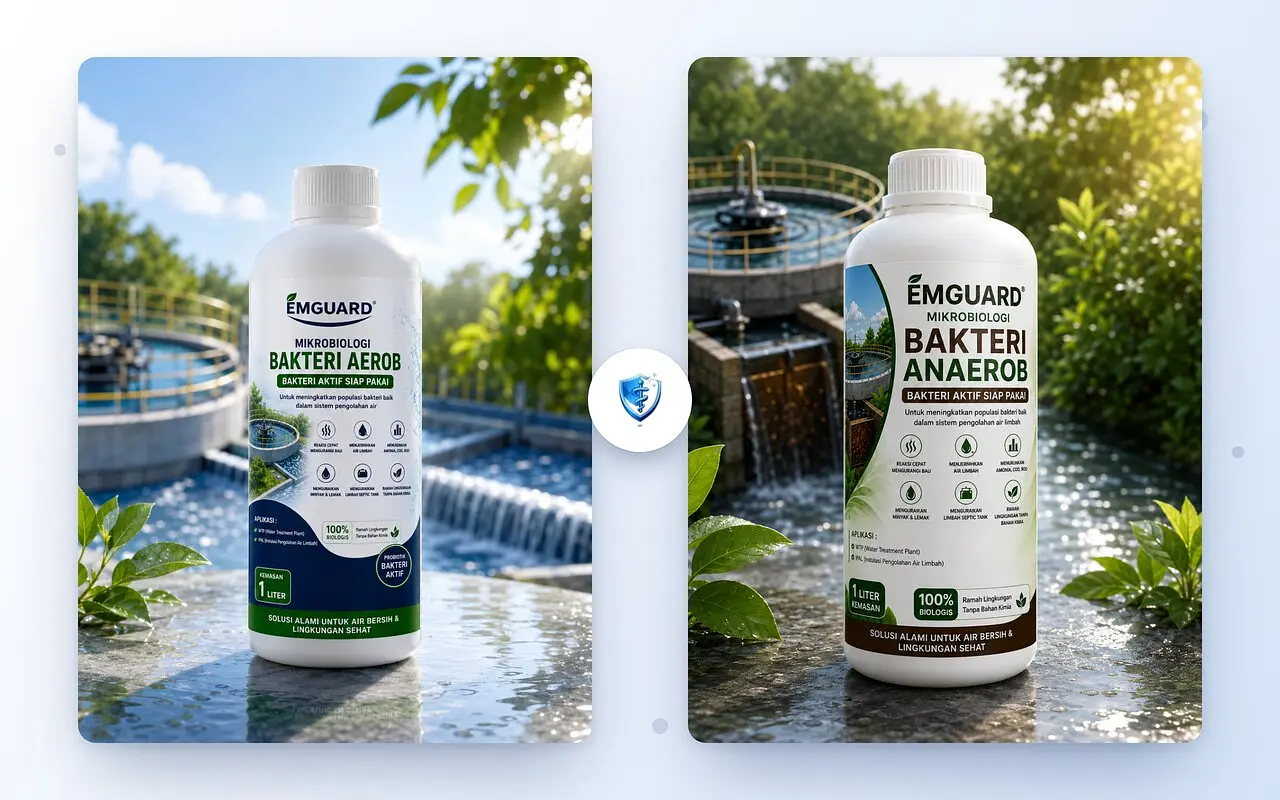
In wastewater treatment, two categories of bacteria are often used interchangeably, as if they were swappable: aerobic and anaerobic. Yet they work differently, handle different kinds of waste, cost differently to operate — and even produce different by-products. Choosing the wrong one is not merely inefficient; it can mean a treatment system that does not work at all.
Here is an honest comparison of the two, explained in full — from basic biochemistry to the practical decision in the field.
The most fundamental difference: oxygen
The dividing line is just one thing — the requirement for dissolved oxygen (DO):
- Aerobic bacteria require oxygen to live and break down waste. Without O₂ they die. That is why an aerobic WWTP always needs an aerator or blower running continuously.
- Anaerobic bacteria work precisely without oxygen. Exposed to significant O₂, they die. An anaerobic system must be sealed — septic tank, biodigester, anaerobic lagoon.
These two categories are not "stronger / weaker." They are different microbial groups with their own strengths and weaknesses — and for different waste contexts.
Mechanism: fast and powerful vs slow and economical
The biochemistry differs fundamentally:
- Aerobic: with oxygen, bacteria fully oxidize organic compounds into CO₂ + water + new biomass. The reaction releases a lot of energy — bacteria grow fast, waste degrades fast.
- Anaerobic: without oxygen, breakdown proceeds via fermentation and methanogenesis. The end products are biogas (CH₄ + CO₂) + a small amount of biomass. The reaction releases little energy — bacteria grow slowly, waste degrades over a longer time, but the system produces a useful gas.
As a result: aerobic systems generally produce clearer effluent in a shorter time (days, not weeks), while anaerobic systems require long retention times but generate far less sludge and can produce biogas you can actually use.
Typical applications: what for, where
This is ultimately what decides which one is chosen:
- Aerobic — suitable for: hospital and clinic WWTPs, office and residential complexes, light industrial zones. Moderate organic load (mild to medium COD), moderate to large volume, a requirement for clear effluent that meets discharge standards.
- Anaerobic — suitable for: household septic tanks, livestock biodigesters (cattle, pigs), food and beverage industry effluents (tofu, palm oil, tapioca), waste with very high COD (above 3,000 mg/L).
Many modern facilities use a two-stage combination: heavy waste first enters an anaerobic reactor (reducing organic load by 60–80%), and its effluent then enters an aerobic reactor for polishing before discharge. Emguard's Aerobic and Anaerobic bacteria are deliberately split for exactly this kind of scenario.
Operating cost: where the difference is most felt
Aeration consumes electricity. That is the single biggest operational reality of an aerobic WWTP — blowers run 24/7 to keep dissolved oxygen up. For larger facilities, aeration electricity can be the biggest component of WWTP OPEX.
Anaerobic is the opposite: once the system is stable, it consumes almost no electricity. The biogas it produces can even be converted into energy (boilers, generators) — turning waste treatment into an energy source.
The trade-off: anaerobic requires a longer retention time (meaning a larger tank for the same volume) and is more sensitive to changes in temperature and pH.
Sludge: one of the hidden burdens
Every WWTP produces biological sludge (excess sludge) that must be pumped out, dewatered, and disposed of. The cost of handling it is real:
- Aerobic systems produce a lot of sludge (about 0.4–0.6 kg of dry sludge per kg of BOD removed) — requiring serious sludge handling.
- Anaerobic systems produce only about 0.05–0.1 kg of sludge per kg of BOD — a dramatic reduction.
For very-high-load waste, this difference alone is reason enough to use an anaerobic stage first.
Sensitivity to chemicals
Both are vulnerable to disinfectants and harsh chemicals entering the inflow:
- Aerobic generally recovers from a shock load faster — because the bacteria grow quickly, the population is rebuilt quickly.
- Anaerobic is far more sensitive — methanogens grow very slowly, so recovery from failure can take weeks to months.
That is why a septic tank "killed" by excessive bleach pours takes a long time to return to normal — see Septic Tank Filling Up Fast and Smelly for a fuller discussion.
Summary: when to use which
- Use aerobic bacteria (aerobic WWTP) when: domestic or light industrial wastewater, moderate organic load, reliable electricity available, clear effluent needed for discharge to a water body.
- Use anaerobic bacteria (septic tank, biodigester) when: highly concentrated waste (food and beverage industry, livestock, household septic tank), wanting to minimize electricity, wanting to harness biogas, with room available for a larger tank.
- Use a combined anaerobic → aerobic when: organic load is very heavy and a discharge-grade effluent is still required.
Conclusion
Aerobic and anaerobic bacteria are not "rivals" — they serve different kinds of waste and different needs. Aerobic is fast and clean but electricity-hungry and produces a lot of sludge. Anaerobic is slow but handles heavy loads, is economical on electricity, and even produces biogas. The best system is not the "strongest" one, but the one most suited to your kind of waste, load, operating budget, and available space.
The Emguard microbiology line is deliberately split along this divide: Aerobic Bacteria Microbiology for aeration-based WWTPs and WTPs, and Anaerobic Bacteria Microbiology for septic tanks, biodigesters, and anaerobic systems.
For concrete application context, also read Microbiology Waste Treatment for Small-Scale Labs and Septic Tank Filling Up Fast and Smelly.
Need to design the right system for your facility? The Emguard team is ready to help via WhatsApp.