Choosing a disinfectant for a hospital is not a small decision. The wrong choice has direct consequences for patient safety, staff health, the budget, even legal compliance. Yet in practice, disinfectants are often picked on lowest price or sheer habit. Here are seven criteria to check before you decide — a practical checklist for procurement and infection-control teams.
1. Microbicidal spectrum and level of disinfection
The first question: what does this product actually kill? A claim of "kills 99.9% of germs" sounds reassuring but explains nothing. What you need to confirm is the coverage: bacteria, enveloped and non-enveloped viruses, fungi, and — for certain areas — mycobacteria and spores.
Disinfectants also have levels: low-level, intermediate-level, and high-level. Operating rooms, ICUs, and emergency departments demand a high-level, broad-spectrum disinfectant; a waiting room may only need intermediate-level. Match the disinfectant's level to the area's level of risk.
2. Contact time — how fast it works
Every disinfectant needs a contact time: the duration a surface must stay wet for microbes to actually die. This is the criterion most often ignored at purchase, yet the most decisive in practice.
A disinfectant that requires a surface to stay wet for 10 minutes is almost impossible to use correctly in a busy hospital — the surface dries long before the time is up. A disinfectant with a short, realistic contact time is far more likely to be used correctly, and a disinfectant used correctly is one that actually works.
3. Regulatory clearance and legality
A surface disinfectant for a healthcare facility should ideally hold a medical-device registration from the Ministry of Health. A registration number is not a formality: it signals the product has passed an assessment, and that the claims on its label can be held accountable.
Buying an unregistered product means carrying two risks at once — a legal risk for the institution, and a quality risk because there is no guarantee its efficacy claims are true. Always ask for and check the registration number.
4. Safety for staff, patients, and surfaces
A good disinfectant kills microbes without creating new problems. Check three things:
- For staff — how irritating is it, does it have a sharp smell or give off disruptive fumes? Staff use it many times a day.
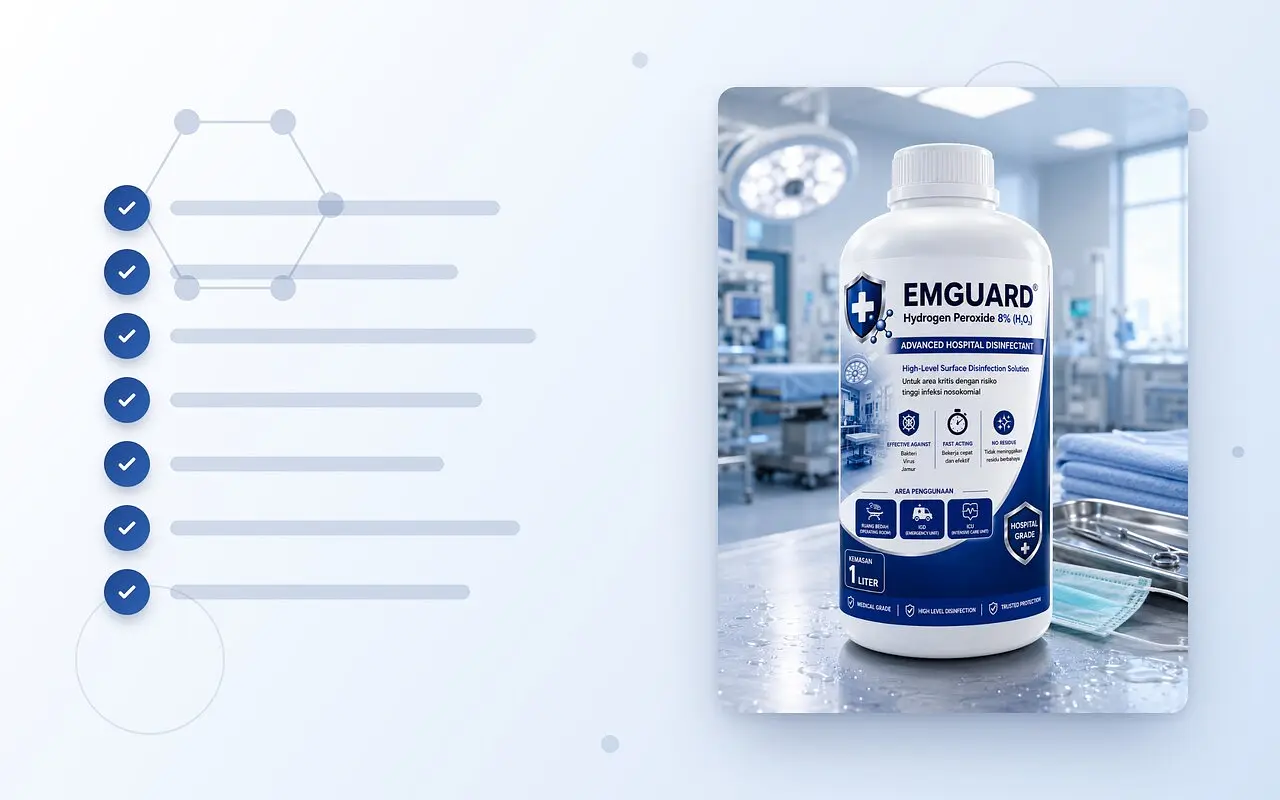
- Residue — does it leave a sticky or hazardous residue layer? Near patients, this is critical. A hydrogen-peroxide-based disinfectant such as Emguard Hydrogen Peroxide 8% breaks down into water and oxygen — leaving no hazardous chemical residue.
- For surfaces and equipment — is it corrosive to stainless steel, plastics, or electronic equipment?
5. Performance against an organic soil load
Hospitals are full of organic matter: blood, body fluids, secretions. Some disinfectants lose their killing power the moment they meet organic soil — the active agent is "spent" reacting with the soil instead of with microbes.
Make sure you know where your product stands: does it remain effective against a moderate organic load, or does it demand a strict pre-cleaning protocol first? Either is acceptable — what is not acceptable is not knowing.
6. Practicality and stability in use
Even the best disinfectant fails if it is hard to use correctly. Consider:
- Ready-to-use or concentrate? A concentrate is more economical but prone to dilution errors — too dilute means ineffective.
- Stability — how long does the product stay effective after it is opened or diluted?
- Application method — spray, wipe, and is it compatible with the cloths or wipes you use?
A disinfectant used wrongly is the same as no disinfectant at all.
7. Test evidence and supplier support
The last criterion separates a serious supplier from a mere seller. Ask for:
- Efficacy test data — laboratory proof that the killing claims are tested, not just printed on the label.
- A Technical Data Sheet (TDS) and Safety Data Sheet (SDS) — basic documents that must be available.
- Supplier support and reliability — continuity of supply, the ability to answer technical questions, and assistance when needed.
A supplier who cannot provide this data is best struck off the list.
A note on cost
Cost does matter, but price per liter is not the real measure. Calculate the cost per use: a heavily diluted concentrate can be far cheaper per application even if the bottle price is similar. And factor in the hidden cost of an ineffective disinfectant — a healthcare-associated infection is far more expensive than the price gap between any two disinfectants.
Conclusion
These seven criteria turn "choosing a disinfectant" from a guess into a checklist: spectrum, contact time, registration, safety, performance against organic soil, practicality, and test evidence. Round it off with an honest cost-per-use calculation.
Emguard Hydrogen Peroxide 8% is designed around exactly these criteria — a high-level, hydrogen-peroxide-based surface disinfectant for operating rooms, ICUs, and emergency departments that kills bacteria, viruses, and fungi without leaving hazardous residue.
To understand why hydrogen peroxide has become a disinfectant of choice for hospitals, read Hydrogen Peroxide 8%: The Hospital Disinfectant That's Often Misunderstood; and to be sure you never confuse a disinfectant with an antiseptic, read Disinfectant vs Antiseptic.
Need test data, technical sheets, or procurement consultation for your facility? The Emguard team is ready to help via WhatsApp.