Vegetative bacteria
Highly effective against Gram-positive (S. aureus, MRSA, Enterococcus) and Gram-negative (E. coli, K. pneumoniae, P. aeruginosa) — the primary causes of nosocomial infections and hand-transmitted diarrhoea.
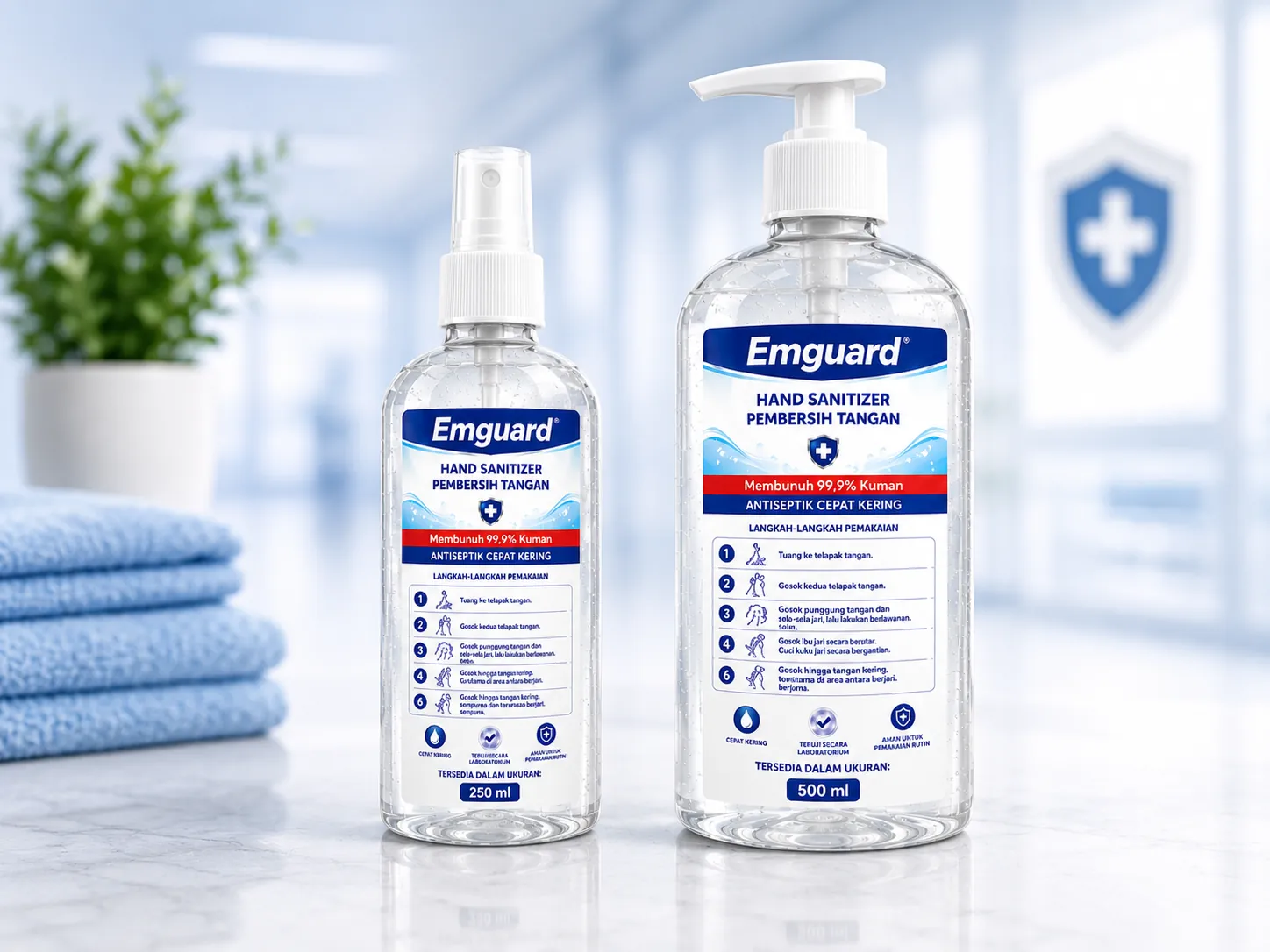
Ethanol is one of the oldest antiseptics known to humankind — used by Joseph Lister in 1867 to revolutionize modern surgery. Its concentration, however, cannot be arbitrary: 70% is the figure chosen by the World Health Organization (WHO) and the CDC as the optimal concentration for killing microbes on the hands. Not 95%, not 50%. The biochemical reason is simple: alcohol works by denaturing proteins — and denaturation requires water. At 70% ethanol + 30% water, the microbial cell is attacked from two directions at once, with a speed and depth that no other concentration can match.
Ethanol kills microbes through two parallel mechanisms that work within seconds. No residue is left behind — all that remains are clean hands free of surface pathogens.
Ethanol dissolves the lipid bilayer of enveloped viruses — SARS-CoV-2, Influenza, HIV, Hepatitis B/C. Viral particles lose their structure within seconds and can no longer attach to host cell receptors.
The water in the 70% formulation allows ethanol to penetrate the bacterial cell wall and deeply denature metabolic enzyme proteins. Without water, ethanol would dry too quickly and coagulate proteins only on the outer surface of the cell.
Ethanol dissolves the lipid components of the cell membrane, causing the leakage of vital ions and metabolites. The microbial cell loses homeostasis and dies within a contact time of 15–30 seconds.
After it has done its work, ethanol evaporates into water vapour and CO₂ — leaving no film, stickiness, or chemical residue on the skin. Glycerol emollients and moisturizers remain on the hands to prevent dryness.
Ethanol 70% has a broad spectrum of action — highly effective against vegetative bacteria, enveloped viruses, and pathogenic yeasts that are the primary source of hand-transmitted infections.
Highly effective against Gram-positive (S. aureus, MRSA, Enterococcus) and Gram-negative (E. coli, K. pneumoniae, P. aeruginosa) — the primary causes of nosocomial infections and hand-transmitted diarrhoea.
Highly effective: SARS-CoV-2, Influenza A & B, Herpes Simplex, RSV, HIV, Hepatitis B & C. Its mechanism of dissolving the lipid envelope makes ethanol the leading choice during respiratory pandemics.
Active against Candida albicans and other opportunistic yeasts. Clinical note: ethanol is less effective against bacterial spores (C. difficile) and non-enveloped viruses (Norovirus) — in these scenarios, wash hands with soap.
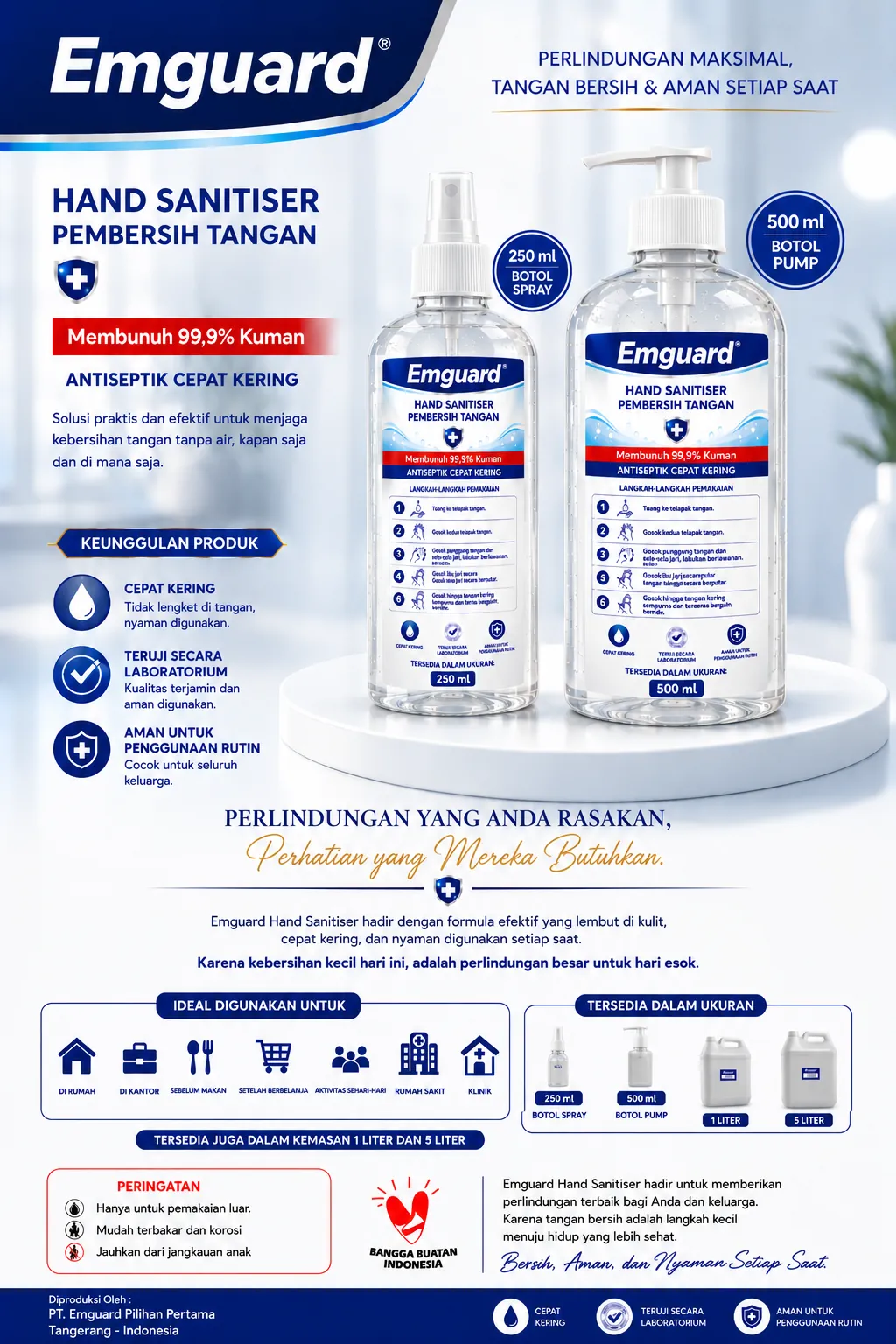
A technical summary of EMGUARD® Hand Sanitizer — ready to share with IPC teams, procurement committees, or end users.
Many people assume that the more concentrated the alcohol, the stronger its antiseptic effect. The biochemical reality is in fact the opposite: at concentrations of 95–99%, ethanol coagulates the proteins of the cell wall so quickly that it forms a protective layer preventing further ethanol from penetrating into the cell. The result: a superficial effect, with microbes inside the cell surviving.
At 70% v/v, the 30% water content allows ethanol to move deeper, denature proteins thoroughly, and dissolve the cell membrane effectively. This is the concentration recommended by the WHO Guide to Local Production: WHO-recommended Handrub Formulations and the CDC Guideline for Hand Hygiene in Health-Care Settings.
Designed for high-touch points and transitional moments — when hands have just touched a public surface and are about to touch a face, food, or another person.
Consistent technique beats a large amount of product. Follow the WHO Six Steps of Hand Hygiene for results that can be replicated every time.
Pour about a full teaspoon, equivalent to two pump presses, onto dry palms. Hand sanitizer is not effective on wet hands — water will dilute the ethanol concentration.
Rub palm to palm, the backs of the hands, between the fingers, the fingertips, and the thumbs in sequence. Make sure the entire surface is wet — including the nail beds where pathogens often hide.
The total rubbing duration is 15–30 seconds, or until the ethanol has fully evaporated. Do not wipe with a tissue — the evaporation process is an integral part of the antiseptic mechanism.
Sanitizer is effective for transient flora but does not replace handwashing when there is visible organic soiling, or after contact with a patient with diarrhoea suspected of C. difficile or Norovirus.
Details ready to attach to procurement documents or a facility formulary.
Ethanol is a flammable liquid. Its safety profile is excellent for skin use, but storage and handling require standard discipline.
Do not use near sources of fire, stoves, lighters, or while smoking. Wait until hands are completely dry before touching surfaces that could potentially trigger a static electricity spark.
Must not be swallowed — ethanol poisoning in children is a real risk. Not to be applied to open wounds, mucous membranes, or the eye area.
Place the dispenser out of reach of children under 6 years old. For use on children, assist with the dose and wait until it is completely dry before they touch their mouth or eyes.
Using large quantities in a small, unventilated room can lead to an accumulation of ethanol vapour. Ensure adequate air circulation in areas of intensive use.
Bacterial spores (C. difficile) and some non-enveloped viruses (Norovirus) are resistant to ethanol. In those scenarios, wash hands with soap & water.
Hand sanitizer is not a replacement for handwashing — it is a bridge to moments when handwashing is impossible. Every dispenser we deliver to an airport, school, or clinic is a small bridge connecting good habits with real-world conditions in the field.
Our technical team is ready to explain the safety profile of ethanol, comparisons with isopropanol formulas, and dispenser recommendations matched to the scale of your facility — from a single clinic to a multi-branch network.