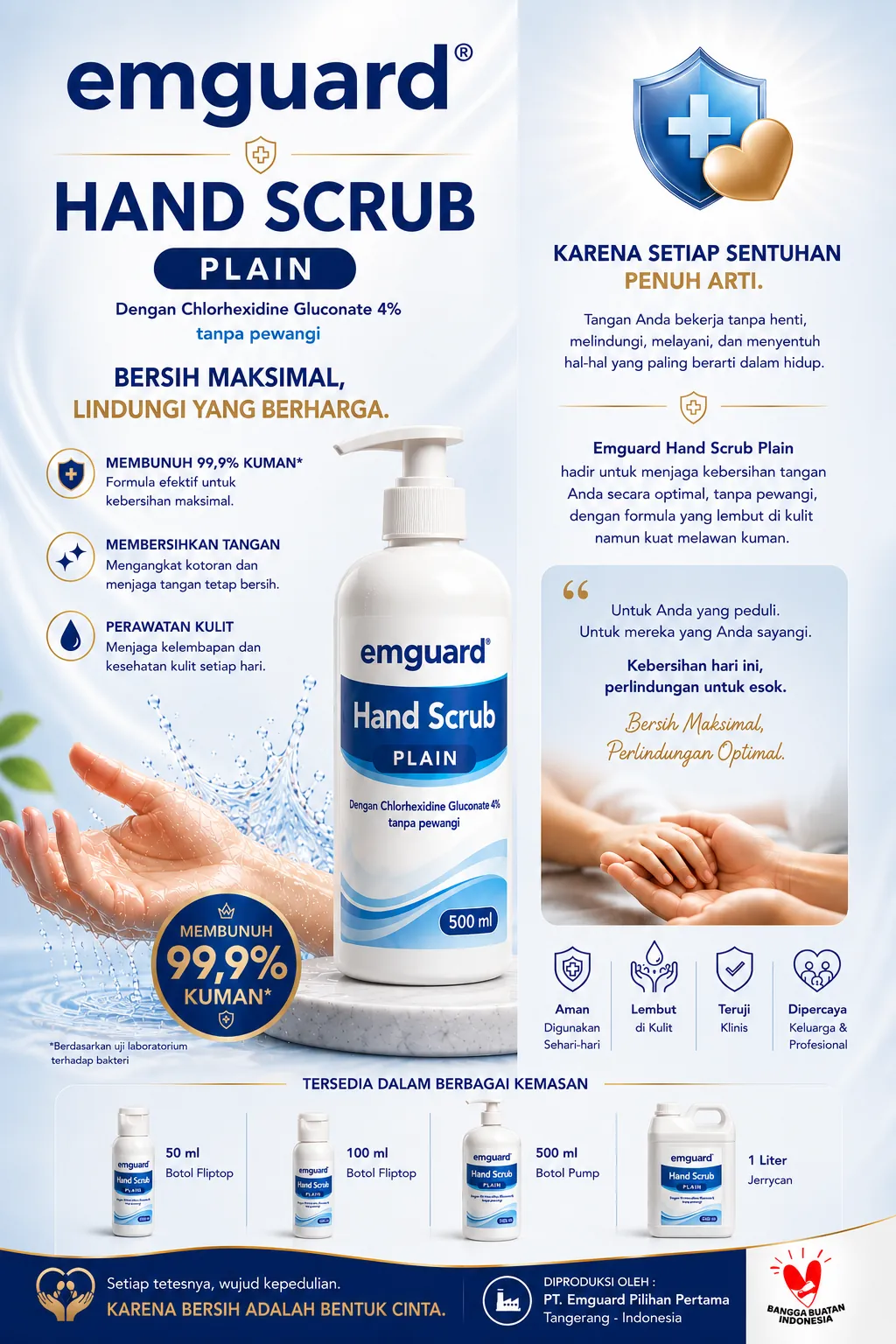
EMGUARD® Hand Scrub Plain — Chlorhexidine Gluconate 4% surgical scrub
EMG-SCRUB · CHG 4% · PLAIN

Hand Scrub Plain
Operating-theatre standard.

A surgical hand antiseptic with Chlorhexidine Gluconate 4% w/v — a fragrance-free formulation that has become the gold standard for the hand preparation of surgeons, OK nurses, and invasive-procedure teams. It delivers residual protection for up to 6 hours — the full duration of a surgical procedure.

  • Active IngredientChlorhexidine Gluconate 4%
  • Packaging500 ml · 1 L · 5 L · elbow dispenser
  • ClassificationSurgical Hand Antiseptic · Pre-operative
  • FormLiquid soap · fragrance-free
— 01 · Scientific Introduction

A surgeon's hands
are the first instrument.

Lord Joseph Lister proved in 1867 that surgical hand antisepsis dramatically reduced post-operative mortality. More than 150 years later, the principle remains unchanged — what has changed is the molecule of choice. Chlorhexidine Gluconate 4% has become the international standard for surgical hand antisepsis because of one property no other antiseptic possesses: substantivity — the ability to bind to the skin's keratin proteins and keep working for hours, including beneath a tight, warm sterile glove.

— 02 · Mechanism of Action

A surgical dose, a duration
matched to the procedure.

At a 4% concentration, CHG works through the same mechanism as lower concentrations — but with a kill speed and residual duration designed specifically for the surgical environment.

  1. 01

    Cationic binding to skin flora

    Positively charged CHG molecules bind to the cell walls of commensal and transient bacteria on the hands with high affinity. Binding occurs within seconds of contact.

  2. 02

    Membrane disruption & cytoplasm precipitation

    At a 4% concentration, CHG rapidly damages the cell membrane — intracellular components coagulate and leak out. Reduction of skin bacterial flora reaches 99.9% within the first 2 minutes of the scrub.

  3. 03

    Substantivity for up to 6 hours

    This is the key clinical differentiator of CHG 4%: the CHG molecule binds to the keratin proteins of the stratum corneum and remains active for up to 6 hours — preventing the regrowth of bacterial flora beneath the sterile glove for the entire duration of the surgical procedure.

  4. 04

    Cumulative effect with routine use

    Clinical literature shows a cumulative antimicrobial effect: surgical teams that consistently use CHG 4% over several days have a persistently lower baseline skin flora than users of povidone iodine or alcohol-based scrubs.

— 03 · Efficacy Spectrum

A surgical spectrum,
an international standard.

Recommended by the WHO Guidelines on Hand Hygiene in Health Care and the CDC Guideline for the Prevention of Surgical Site Infection as the antiseptic of choice for surgical hand preparation.

Surgical pathogenic bacteria

Rapid reduction against S. aureus, MRSA, S. epidermidis (a common cause of surgical site infection), Enterococcus, E. coli, and P. aeruginosa. Effective against commensal skin flora at risk of translocation when the hands are gloved.

Enveloped viruses

Effective against HIV, Hepatitis B & C, SARS-CoV-2, Herpes Simplex — relevant to procedures with a potential exposure to blood and body fluids.

Yeasts & fungi

Active against Candida spp. including C. auris, a global concern for nosocomial infections in immunocompromised patients.

— 04 · Visual Guide

One sheet,
the entire product profile.

A technical summary ready to share with the OK, IPC, and hospital procurement teams.

EMGUARD® Hand Scrub Plain brochure — Chlorhexidine Gluconate 4%, fragrance-free.
Official brochure · EMGUARD® Hand Scrub Plain · Proudly Made in Indonesia
— 05 · Why 4% & Fragrance-Free

A surgical concentration,
a sterile profile.

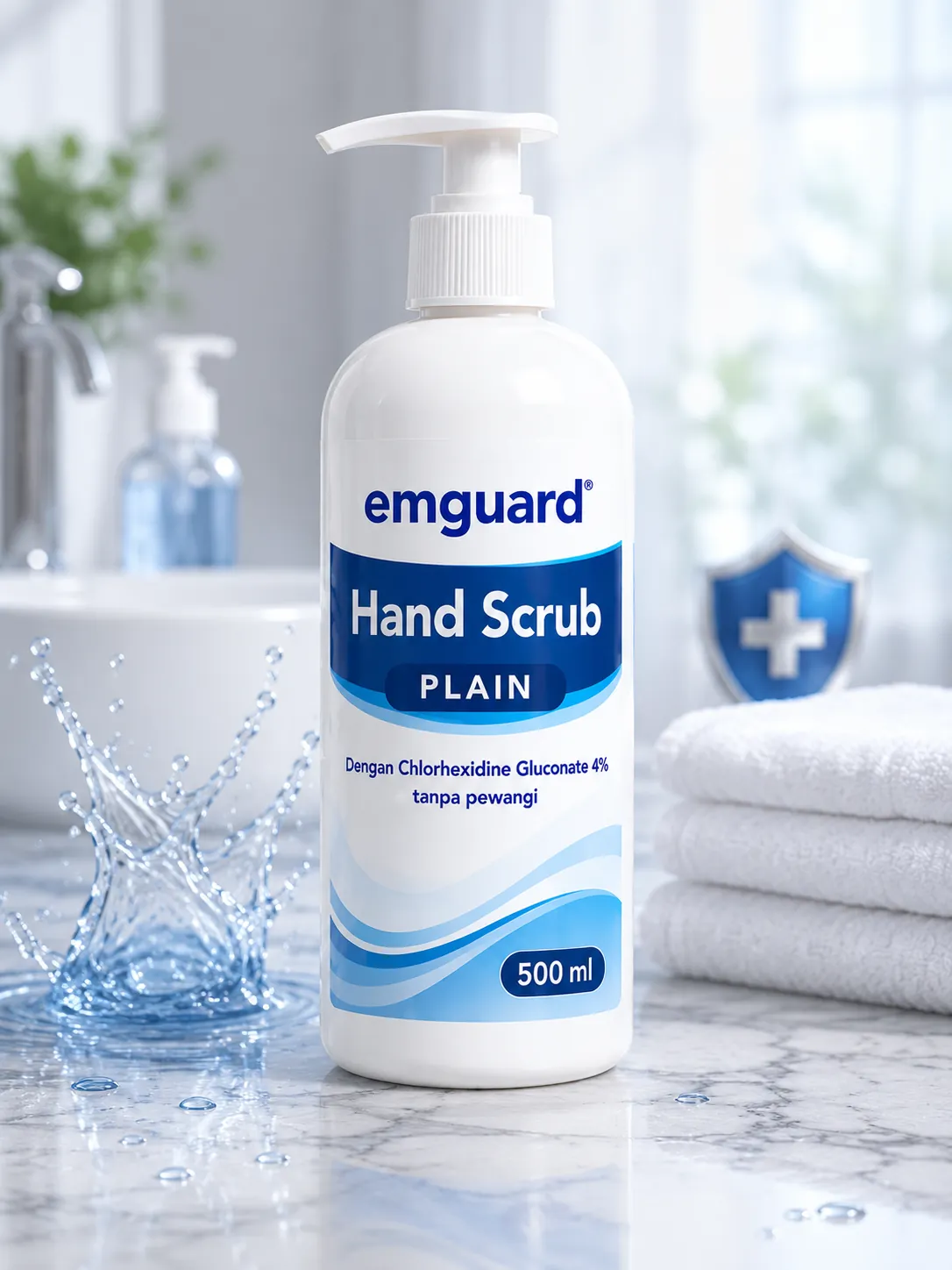
A 4% concentration is the clinical figure established by surgical antisepsis literature over the past 50 years. This is no arbitrary concentration — at 4%, CHG achieves a sufficiently rapid bactericidal kill within a standard 2-minute scrub, while also delivering the 6+ hours of substantivity needed for lengthy surgical procedures.

The Plain (fragrance-free) version is chosen by surgical teams for three operational reasons: first, some patients and staff are hypersensitive to perfume in the enclosed environment of the OK; second, fragrance can cling to sterile drapes and interfere with the sense of smell of anaesthetists, who rely on smell to detect gas leaks; third, laboratory efficacy evaluations are conducted without sensory interference.

Povidone Iodine 7.5%
The classic alternative — its dye leaves stains, with a higher irritation profile.
CHG 4% Plain (EMGUARD)
The gold standard for surgical scrub · 6-hour substantivity · stain-free.
Alcohol-based scrub
Fast but with no residual effect — re-application between procedures is required.
— 06 · Clinical Applications

For procedures where
contamination is not tolerated.

Every surgical area and invasive procedure shares the same standard expectation: hand preparation that is auditable and validated.

Operating Theatre (OK)
Pre-operative surgical scrub
ICU
Central venous catheter insertion
Cath Lab
Interventional cardiology procedures
Delivery Room
Normal delivery · C-section · invasive obstetrics
Minor Surgery Clinic
Skin surgery · procedural dermatology
Dental Clinic
Oral surgery · implants · invasive scaling
— 07 · How to Use

Two to five minutes —
the surgical scrub standard.

A surgical scrub technique validated by AORN (Association of periOperative Registered Nurses) — a duration and sequence that must never be cut short.

  1. Step 01

    Preparation: remove jewellery, trim nails, inspect the skin

    Remove all hand and wrist jewellery. Nails must be short (≤2 mm from the fingertip) with no nail polish, acrylic nails, or long nails. Inspect the skin for wounds or lesions.

  2. Step 02

    Pre-rinse with warm running water

    Wet the hands up to the elbows with warm water. Apply 5 ml of Hand Scrub Plain to the wet palms. Build a rich lather, then distribute it from the fingertips to 5 cm above the elbows.

  3. Step 03

    Scrub for 2–5 minutes in a systematic sequence

    Use a soft single-use brush on the nails and fingertips (30 seconds per hand). Then scrub with your own hands: fingers (4 sides of each finger, 10 counts), palms, backs of the hands, up to the elbows. Always keep the hands higher than the elbows.

  4. Step 04

    Rinse, dry with sterile gauze, don sterile gloves

    Rinse from the fingertips to the elbows — let the water flow towards the elbows. Dry with sterile gauze using a press-not-rub technique, from the fingertips towards the elbows. Continue with sterile gowning and gloving.

— 08 · Technical Specification

Composition & technical data.

Details ready to attach to procurement documents, IPC/IPCN evaluations, or your facility's formulary.

Product Name
EMGUARD® Hand Scrub Plain
Product Code
EMG-SCRUB · CHG 4% · PLAIN
Category
Surgical Hand Antiseptic — Pre-operative
Active Ingredient
Chlorhexidine Gluconate (CHG) — 4% w/v
Surfactant
Mild non-ionic blend, compatible with CHG
Emollient
Glycerin for skin barrier recovery after the scrub
Dosage Form
Thick liquid soap, rich lather, pH 5.5–6.5
Fragrance
Fragrance-free
Packaging
500 ml · 1 L bottle · 5 L jerrycan · Elbow-operated dispenser
Efficacy Spectrum
G+/G− bacteria, enveloped viruses, pathogenic yeasts
Substantivity
Up to 6 hours of residual activity
Reference Standard
WHO Surgical Hand Antisepsis · AORN Recommended Practices
Manufacturer
PT. Emguard Pilihan Pertama · Tangerang, Indonesia
— 09 · Safety & Warnings

For professional hands,
with clinical caution.

A 4% concentration requires slightly more disciplined handling than lower-strength formulations. The following are important notes for surgical and housekeeping teams.

  • Avoid contact with the eyes, middle ear, and meninges

    CHG is not indicated for the middle ear due to the risk of ototoxicity, or for direct application to the meninges (brain tissue). For pre-operative skin antisepsis on the face and head, use carefully around the eyes.

  • Avoid use on premature infants

    CHG can be absorbed through the immature skin of premature infants. For premature neonates, use a specialised formulation or an alternative in accordance with neonatology protocols.

  • Hypersensitivity reactions — rare, but real

    Anaphylaxis to CHG is very rare but documented. Check the patient's allergy history before applying pre-operative skin prep, and document any reactions after use.

  • Do not mix with anionic soaps or iodine

    Cationic CHG loses its activity when mixed with conventional anionic soaps. Do not use after povidone iodine on the same skin surface without thorough rinsing.

  • For external use on intact skin only

    Must not be swallowed. Avoid application to deep open wounds. Keep out of the reach of children without supervision.

— 10 · Storage

Store it correctly,
and efficacy is preserved.

  • Temperature: Store at room temperature (15–30°C). Avoid freezing, which can alter the viscosity.
  • Light: Avoid direct sunlight exposure — store in an air-conditioned OK store room.
  • Packaging: The elbow-operated dispenser system reduces cross-contamination. Avoid repeated refilling of opened bottles.
  • Dispenser system: Clean the dispenser every 6 months in accordance with hospital SOPs. Carry out periodic visual checks for biofilm.
  • Stock rotation: Apply the first-in, first-out principle in accordance with the production date on the label.

Every surgeon begins a procedure with the same ritual for a full two minutes. It is not a formality — it is the first line of defence against surgical wound infection. We formulated EMGUARD® Hand Scrub Plain as a clinical instrument for that ritual, not as a soap.

EMGUARD Formulation Team Product philosophy
— Technical questions?

Talk to the formulation team.

Our technical team is ready to provide the MSDS, efficacy test certificates (in-vitro time-kill assay), and recommendations for elbow-operated dispenser systems for your OK.

Schedule a consultation Back to catalogue