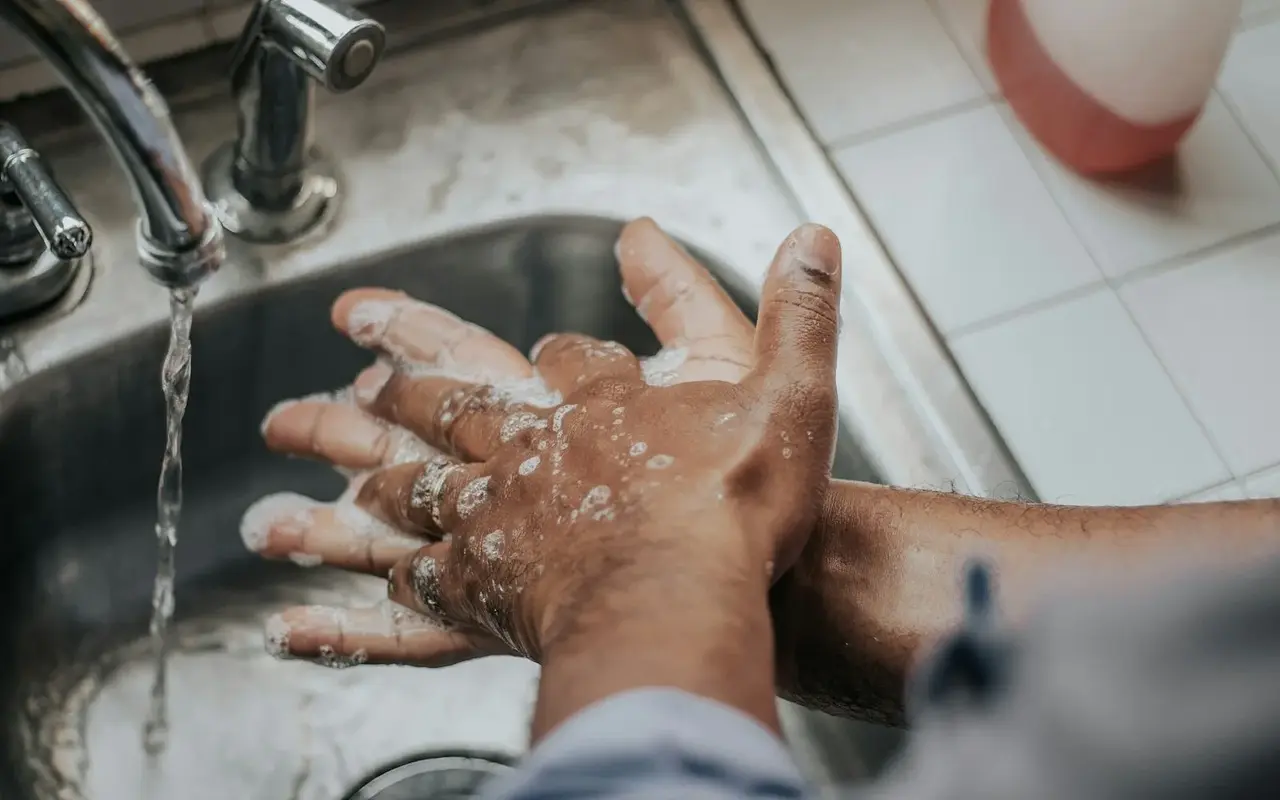
The WHO six steps of hand hygiene have been the global gold standard since 2009. Every Indonesian nurse and doctor is taught the sequence in basic education. It's posted at every hospital sink. Yet compliance audits consistently show the same result: technical compliance (all 6 steps performed correctly) is only 30–45% on average at Indonesian hospitals, even when "did wash hands at all" compliance reaches 70%+.
The gap isn't about knowing or not knowing — it's about execution details that get casually skipped. This article walks through WHO's 6 steps with focus on the operational mistakes most often found during direct observation, and how IPC nurses can audit accurately.
Before the 6 steps: remember the 5 Moments first
Perfect technique at the wrong moment = wasted effort. Before focusing on "how," make sure "when" is clear: see WHO 5 Moments of Hand Hygiene. This article assumes the moment is right — now we focus on technique.
Important note: WHO's 6 steps apply to both hand rub (alcohol) and hand wash (soap + water). The sequence is identical; only the duration differs:
- Hand rub: 20–30 seconds total (until alcohol is dry)
- Hand wash: 40–60 seconds total (wet to dry)
For surgical hand scrub, the procedure differs and is longer — see the WHO surgical hand scrub guide.
Preparation before washing
Four things often unchecked but affecting effectiveness:
- Remove jewelry — rings, watches, bracelets. Bacterial load is 10× higher in their crevices than on bare skin.
- Nails short and clean — no nail polish, no artificial nails. The subungual area is a P. aeruginosa reservoir.
- Sleeves rolled — at minimum above the wrist, so they don't block washing all the way to the wrist.
- Non-touch sink, or pedal/sensor — if manual tap, open before washing and close with a tissue (not the now-clean hand).
The 6 WHO steps — with the common mistake at each
Step 1: Palm to palm
How: Apply soap (3–5 mL hand wash) or hand rub (3–5 mL alcohol) onto the palm. Rub both palms together in a circular motion. Make sure every palm area is wet with the product.
Common mistake:
- Product volume too small — soap/rub runs out before step 6 is done. For hand rub: if alcohol evaporates in <20 seconds = under-volume; repeat.
- Rubbing too fast and too light, no pressure. Friction is part of cleaning.
- Skipping this step because of haste and jumping to step 2.
Step 2: Right palm over left dorsum with fingers interlaced — and the reverse
How: Place the right palm on the back of the left hand. Fingers interlocked. Rub back and forth. Make sure the spaces between fingers are touched. Repeat the reverse: left palm on right dorsum.
Common mistake:
- Fingers not truly interlocked — just stacked on top. The finger spaces don't get reached.
- Only one direction; the reverse is forgotten. Or one side is shorter than the other.
- The back of the hand is missed — motion stays on the palm.
Step 3: Palm to palm with fingers interlaced
How: Palms face each other again, this time with fingers interlaced more deeply. Rub back and forth. Target area: between the fingers, intensively.
Common mistake:
- Fingers interlaced only at the tip, not the base. The proximal finger spaces still aren't reached.
- Movement too quick without pressure — fingers just cross, no friction.
- Treated the same as Step 1 (palm-to-palm without interlace) — but the area being cleaned differs.
Step 4: Backs of fingers to opposing palms with fingers interlocked
How: Bend the fingers of one hand toward the other so the backs of fingers contact the palm. Form an interlocked grip. Rub the back of the fingers back and forth. This is the step that cleans the fingertips and the dorsal phalanges.
Common mistake:
- Not truly interlocked — fingers touch lightly without pressure.
- Only one side, forgetting to swap.
- Often dismissed because the position is awkward — yet this step cleans the fingertips (the part most in contact with patients).
Step 5: Rotational rub of the left thumb clasped in the right palm — and the reverse
How: Grasp the thumb of one hand with the palm of the other. Rotate in a circular motion for 3–5 seconds. Repeat on the other thumb.
Common mistake:
- The most-skipped of all 6 steps. Observational studies find Step 5 done in only 50–60% of audits.
- Only touching the thumb without rotating — the rotation matters for all sides.
- The product is already gone by this step because not enough was applied at the start.
Step 6: Fingertips clasped in palm — rotational rubbing both ways
How: Gather the fingertips of one hand and rotate them in the palm of the other with a forward-and-back circular motion. Repeat on the other hand. This step cleans the subungual area (under the nail) — the area with the highest microbial load.
Common mistake:
- The most-skipped step after Step 5.
- Not rotating — just pressing fingertips into the palm briefly.
- Skipped entirely because "wash is finished."
The "step 7" WHO often gets forgotten: the wrists
WHO actually recommends extending to the wrists after the 6 main steps, especially in a clinical context. Many Indonesian guides add this as an informal Step 7:
How: After Step 6, continue rubbing the wrist (up to 2–3 cm above the wrist) with a circular motion. Repeat for both wrists.
The wrist is a transition area often in contact with sleeves, gloves, and surfaces — it should be included.
After the 6 steps
For hand wash (soap + water):
- Rinse with running water, from wrist toward fingertips — letting water carry the soap + microbes loose into the sink
- Dry with a single-use tissue or individual towel. Avoid air dryers — they aerosolize microbes
- Close the tap with the used tissue (not with newly-clean hands)
For hand rub (alcohol):
- Continue rubbing until the alcohol is completely dry (15–20 seconds for the right volume)
- No tissue drying needed — air-drying is the process's natural end
- Dry hands = ready to provide care
Most common field mistakes (summary)
- Duration too short. Quick check: 6 steps × 3–5 seconds each = 20–30 seconds total for rub. If finished in 10 seconds = a step was skipped or shortcut.
- Product volume too small. If hand rub runs out before step 6, the volume was insufficient. Reapply.
- Steps 5 and 6 skipped. The two most-omitted steps — yet they clean the thumb + fingertip area (highest contamination).
- Wrist neglected. Stopping at the wrist = a transition area that's still dirty.
- Sleeves long. Clean hands, damp/dirty sleeves → recontamination when donning gloves.
- Jewelry not removed. A ring = a microbial reservoir. Mandatory removal in clinical units.
- Forgetting to wash after removing gloves. Gloves leak 4–12% during use. Hands must be washed after removal.
- Air dryer used. Aerosolizes microbes + water circulates around the bathroom. Always single-use tissue.
How IPC nurses audit accurately
A valid hand hygiene audit needs methodology, not just standing near the sink. Four principles:
1. Blind (covert) observation
Staff who know they're being audited change behavior — the well-documented Hawthorne effect. The observer should pose as auxiliary staff or a visitor. If not possible, at least observe from a distance the staff don't detect.
2. Consistent case definitions
Use the WHO Observation Form every audit. Per moment (per the 5 Moments), record: done/not. For technique, use the 6-step checklist — call it "technical compliance" only if all 6 steps are complete.
3. Minimum sampling
At least 20 observations per unit per month for representative data. Per shift (morning/afternoon/night) to capture variability. Auditing only morning rounds will bias because conditions haven't peaked.
4. Feedback to the unit with an improvement plan
An audit result left in a report = useless. Share with the unit team in a monthly meeting, identify patterns (e.g. Step 5 always skipped in the ER), and agree on measurable improvement steps.
For a stronger audit, combine with ATP swab on high-touch surfaces or HAI surveillance results per unit — does technique audit correlate with falling infection rates?
For broader context
WHO's 6 steps are the foundational technique. For a fuller view of the hospital hand hygiene ecosystem:
- 5 Moments of Hand Hygiene — when to wash
- Hand Rub vs Hand Sanitizer vs Hand Wash — which product for which situation
- Surgical Hand Scrub — the more intensive version for surgical staff
- Healthcare worker hand irritation — why compliance drops when products irritate
- Healthcare-Associated Infections (HAIs) — the complete framework for why hand hygiene matters
What Emguard provides
Emguard's hand hygiene line is designed to support consistent 6-step compliance:
- Hand Rub Antibacterial — 70% alcohol + emollient formulation; non-irritating even at 30–80 applications per shift. Per-application volume is enough for a full 6 steps.
- Hand Wash Antibacterial — pH-balanced, mild surfactants. For washes when hands are visibly soiled.
- Hand Sanitizer — portable for mobile staff (ER, ambulance, outpatient).
In addition: we provide laminated WHO 6-step + 5 Moments posters in Bahasa Indonesia to post in scrub rooms and hand-wash areas, free for customers. Reach out via WhatsApp below.
Summary
WHO's 6 steps look simple — but audits show technical compliance is only 30–45% in Indonesian hospitals. What separates consistent staff from sloppy ones: enough duration (20–30 sec for rub, 40–60 for wash), sufficient product volume, and discipline at steps 5–6 that are most often skipped. For IPC nurses: blind audits, adequate sampling, improvement-oriented feedback — that's what turns audit data into an improvement tool, not just a report.