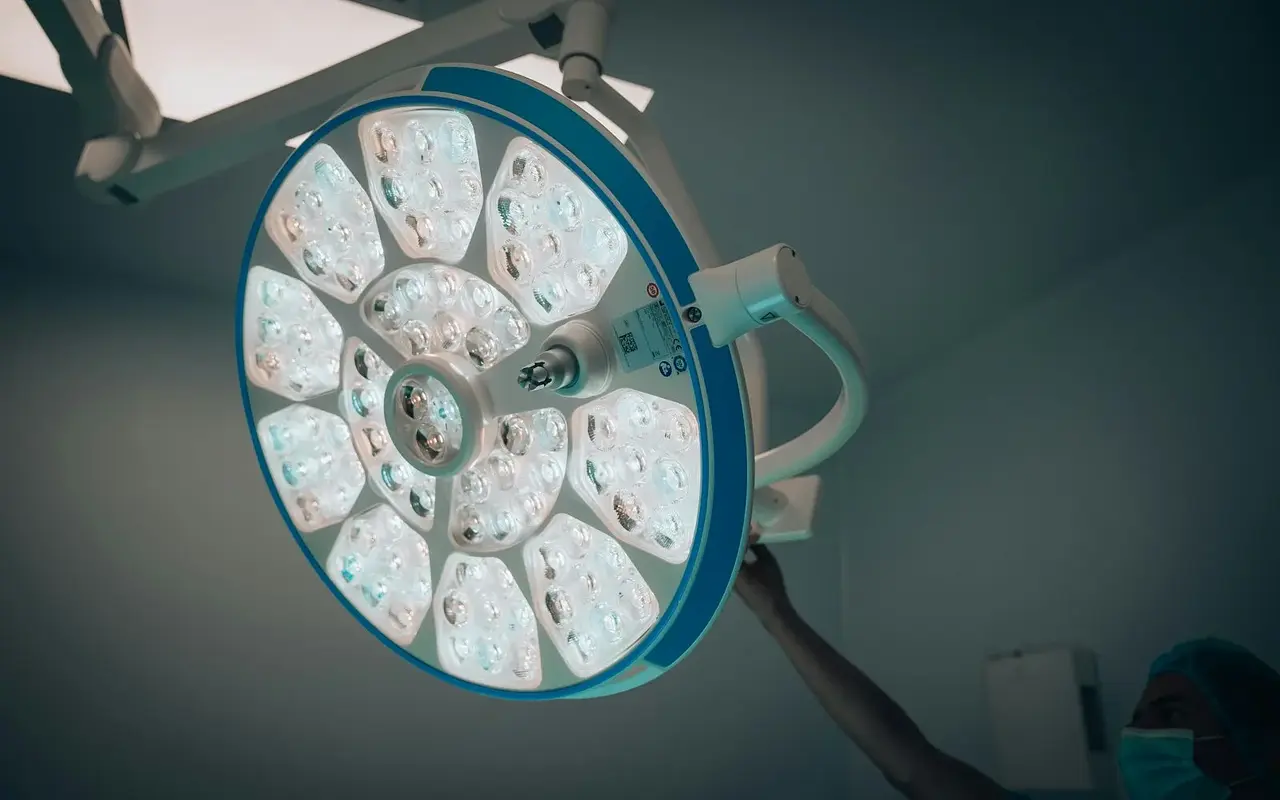
The operating room (OR) carries the strictest disinfection standard in a hospital. Patients with open skin, sterile tissue exposed, invasive instruments — these conditions make even the smallest microbial contamination capable of causing a surgical site infection (SSI). WHO data shows SSIs account for 11% of all healthcare-associated infections in developing countries — and many can be prevented with a consistent disinfection protocol.
This article explains an OR disinfection framework consistent with WHO, CDC, and Minister of Health Regulation 27/2017 on Infection Prevention and Control: zones, frequency, product selection, and verification methods.
Three zones in the surgical suite
Not every part of the OR receives the same treatment. Zoning drives the protocol:
- Restricted (sterile) zone — operating table, scrub area, sterile instrument prep. Limited access, all staff masked and capped. Strictest disinfection.
- Semi-restricted zone — corridors between ORs, sterile-instrument storage, pre-induction. Access for staff in OR scrubs. Still high standard, but less frequent.
- Unrestricted zone — changing rooms, administrative areas, staff waiting. Regular hospital standard.
Surface and instrument classification (Spaulding)
The Spaulding framework classifies items by contamination risk to the patient:
- Critical — contact with sterile tissue or bloodstream (surgical instruments, implants). Must be sterilized, not just disinfected.
- Semi-critical — contact with mucosa or non-intact skin (endoscopes, laryngoscopes). High-level disinfection.
- Non-critical — contact with intact skin (tables, trolleys, floor, walls). Intermediate or low-level disinfection.
This article focuses on non-critical surfaces — the areas that fall under the daily cleaning team's responsibility. For sterilization of critical instruments, use your CSSD (Central Sterile Supply Department) per the hospital's own procedure.
Four tiers of disinfection frequency
1. Between cases
After one operation ends, before the next patient enters:
- Dispose of all linen and disposables
- Pre-clean: remove blood, tissue, body fluids with a damp microfibre cloth
- Disinfect every horizontal surface (OR table, instrument trolley, monitor, lamp) with an intermediate-level disinfectant (H2O2 7–8% or sodium hypochlorite 1,000 ppm)
- Honor the contact time — leave wet for 5–10 minutes, don't wipe dry too early (see the contact time article)
- Replace bins, scrub-sink soap, towel dispensers
Typical time: 15–25 minutes, depending on the previous case's complexity.
2. Terminal cleaning (end of day)
After the day's last operation. This is the most comprehensive disinfection:
- Remove all items from the room
- Disinfect vertical surfaces (walls, doors, windows, AC vents)
- Disinfect all horizontal surfaces from top to bottom
- Floor: mop with disinfectant, contact time minimum 10 minutes
- If needed (e.g. post-isolation or infectious cases): fogging or UV-C
- Re-stock the inventory
Typical time: 45–90 minutes for a standard-sized OR.
3. Interim cleaning (scheduled)
For an OR that isn't in use throughout the day but is on standby — light disinfection every 4–8 hours to maintain readiness.
4. Weekly deep clean
Once a week, or when the OR is scheduled idle:
- Wash walls floor-to-ceiling
- Clean HVAC filters (or coordinate with the engineering team)
- Disinfect hard-to-reach areas: behind fixed equipment, behind trolleys, cable management
- Visually inspect surface integrity — cracks in paint = contamination vectors
Product selection by situation
SituationProductConcentrationContact time Routine surfaces between casesH2O27–8%5–10 min FloorHypochlorite / H2O21,000 ppm / 8%10 min Blood / body-fluid spillsHypochlorite5,000 ppm10 min Metal surfaces (non-critical instruments)Alcohol70%Air-dry Terminal post-C. difficile isolationHypochlorite / H2O25,000 ppm / 8%10–15 min + foggingFor general disinfectant selection, see 7 criteria for choosing a hospital disinfectant. For the technical difference between disinfectants and antiseptics, see the related article.
Detailed terminal-cleaning protocol
This is the protocol used by many Type A and B hospitals in Indonesia, adapted from WHO / AORN guidance:
Preparation
- Staff: full PPE (gloves, mask, apron, dedicated shoes)
- Keep the ventilation/HVAC running throughout the process
- Prepare 2 buckets: one disinfectant, one clean water for rinsing
- Use new microfibre cloths — one cloth per area, never shared
Cleaning order
- Cleanest to dirtiest area (ceiling → walls → surfaces → floor)
- Top to bottom
- Back of the room toward the exit door
- Every surface wiped in layers: pre-clean once (mild detergent), rinse, then disinfect
- Wait the full contact time before using the surface again
After completion
- Dispose of single-use PPE
- Wash hands per the 5 Moments of hand hygiene
- Log it: date, time, staff, last case, products used
- Supervisor sign-off before the OR is released to the next schedule
How to verify the disinfection was effective
Without verification, "the OR has been disinfected" is not auditable. Four common methods:
- Visual inspection. No blood, dust, or spill residue. Mandatory, but not sufficient — many pathogens are invisible.
- Fluorescent marker (DAZO or similar). An invisible marker placed on high-touch points before cleaning, checked under UV after. Anything still glowing = not wiped. Cheap, easy, widely used.
- ATP swab test. Measures organic residue (a proxy for cleanliness). Result in <30 seconds. Typical target <250 RLU for OR surfaces.
- Microbiology swab. Surface sample post-disinfection, lab culture. Gold standard but 2–5 day results. Run routinely (weekly/monthly) at critical points.
A common combination: daily DAZO for staff-compliance audit, weekly ATP for validation, monthly microbiology for final verification.
The most common field mistakes
- Disinfectant diluted off-label. "Saves money" — but voids efficacy. Use the dilution chart posted in the scrub room.
- One microfibre cloth for the entire room. This spreads pathogens, doesn't remove them. One cloth per area, washed at 60–70°C between shifts.
- Contact time cut short. Floor sprayed then immediately wiped dry = microbes still alive. Set a 10-minute timer.
- HVAC positive pressure not maintained. The OR should be at higher pressure than the corridor (positive pressure), so air flows outward when the door opens. HEPA filters must be checked routinely.
- No independent audit. A cleaning team auditing itself = bias. IPC or an independent team must spot-check at least weekly.
- Switching disinfectant without a transition plan. When changing products, there's a learning-curve period — contact time, dosing, compatibility with different surfaces. Pilot 30 days in one OR before rollout.
Emguard products for the OR environment
Emguard's range provides disinfectants and antiseptics appropriate for OR standards:
- Hydrogen Peroxide 8% — the primary surface disinfectant; no corrosive residue, suitable for operating tables, trolleys, and non-critical instruments.
- Hand Rub Antibacterial — for the scrub team between procedures (in the scrub area before gloving).
- Hand Scrub Plain — unscented surgical scrub for pre-surgical hand prep.
- Hand Sanitizer — outside the scrub area (induction room, inter-OR corridors).
Our team is regularly invited to audit cleaning protocols at existing ORs and produce updated, laminated dosing charts to post in scrub rooms. Reach out via WhatsApp below.
Summary
Good OR disinfection is operational discipline, not expensive technology. Four frequency tiers (between, terminal, interim, weekly), clear zoning, the right product for each situation, and routine verification — that is the framework. What separates hospitals with low and high SSI rates is not the cleaning budget but execution consistency: contact times honored, one cloth per area, independent audits, and ongoing staff training.